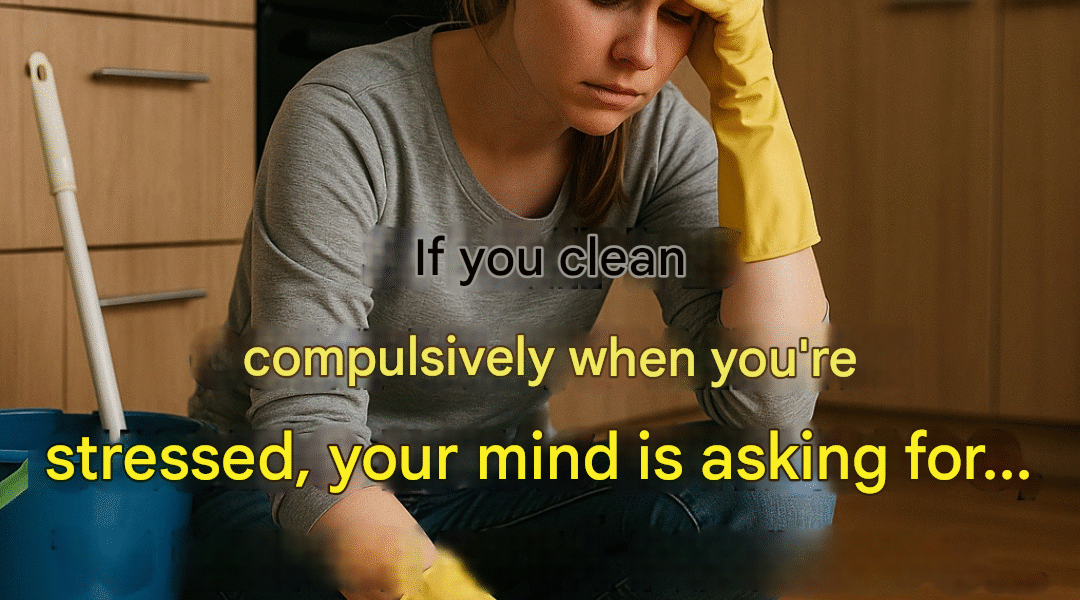
If you compulsively clean when you’re stressed, your mind is asking for help in this way
Many people react to stress in unexpected ways: some overeat, others can’t sleep, and some start cleaning compulsively. The curious thing is that, for the latter, cleaning is not only about maintaining order in the house, but a way of trying to control internal chaos.
If you’ve caught yourself passing the broom over and over again or washing dishes non-stop when you’re feeling anxious, your mind could be sending you an important message.
What does it mean to compulsively clean when we are stressed?
Compulsive cleansing is not simply a habit: it is an emotional and psychological response that reflects what is happening inside us. By ordering the external environment, we unconsciously seek to order our emotions as well.
Reasons why it happens
- Need for control: When we feel that life is slipping out of our hands, tidying up space gives a sense of mastery over something specific.
- Reduced anxiety: The repetitive motion of cleaning releases accumulated tension and produces momentary relief.
- Distraction from the real problem: Instead of facing the cause of stress, the mind focuses on a task that takes up time and energy.
- Cultural and Family Association: Many people grew up hearing that “a clean house reflects a healthy mind,” which reinforces this behavior.
- Symptom of an underlying disorder: In more severe cases, it may be related to obsessive-compulsive disorder (OCD) or generalized anxiety.
Cleanliness as the Hidden Language of the Mind
Order as a refuge
The act of cleaning offers a safe space. The organized environment can give the illusion of calm when inside we feel the opposite.
When cleaning becomes an escape
Some people find that they spend hours cleaning without realizing it. This is not simple discipline: it is a way of running away from difficult thoughts or emotions that generate pain.
Difference Between Habit and Compulsion
- Habit: You clean because you enjoy a tidy space.
- Compulsion: You clean because not doing so causes you anguish or because it is the only way you feel temporary relief.
Tips for coping
- Recognize the pattern: Notice when you clean for pleasure and when you do it to calm a negative emotion.
- Look for alternatives: Practicing deep breathing, journaling, or going for a walk are healthy ways to manage anxiety.
- Set time limits: Decide how much you will dedicate to cleaning and respect it, preventing it from taking up all your energy.
- Talk about what you’re feeling: Sharing your stress with a family member, friend, or professional can be more effective than compulsively sweeping.
- Don’t blame yourself: Remember that your reaction is a defense mechanism; the important thing is to learn how to manage it better.
If you compulsively clean when you’re stressed, your mind isn’t obsessed with dust: it’s looking for a respite, a safe space in the midst of emotional clutter. Listening to that message and heeding it can help you not only have a clean home, but also a calmer, more balanced mind.