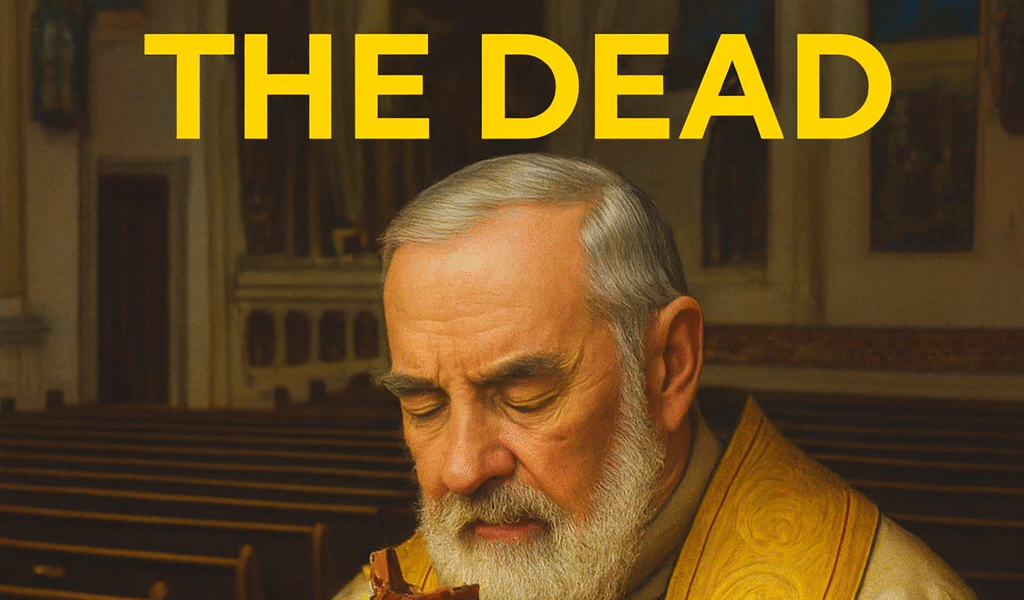
What It Means to Dream of a Deceased Loved One: Padre Pio’s Spiritual Teaching
When a loved one who has already passed away appears in your dreams, it rarely feels like a mere memory.
There is something different: the dream is clearer, more real, more intense. When you wake up, your heart is stirred, as if you have somehow been with that person again.
Christian spirituality, and in particular the witness of St. Padre Pio of Pietrelcina, invites us to look at these experiences with the eyes of faith and not only as a psychological phenomenon. Without falling into superstitions or forbidden practices, the Church recognizes that God can also use dreams to touch the soul, console, correct or ask for prayer for the dead.
In this article we are going to delve, in the light of Padre Pio’s life and teachings, into what it can mean to dream of a deceased loved one, how to discern those dreams and, above all, how to respond in a Christian and prudent way.
Padre Pio: A Credible Witness of the Spiritual World
Before talking about dreams and the deceased, it is important to understand who Padre Pio was and why his words carry so much weight on these issues.
St. Padre Pio (Francesco Forgione), born in 1887 in Pietrelcina (Italy), lived from childhood a deep spiritual sensitivity. Later, as a Capuchin friar, God granted him extraordinary graces:
- The stigmata (Christ’s wounds on his own body).
- Bilocation, that is, being able to be mystically and miraculously in more than one place.
- Gift of reading hearts, helping thousands of souls in the confessional.
He spent hours and hours confessing, celebrating the Eucharist, and offering sacrifices for others. His life was rigorously examined by the Church, and after numerous trials and testimonies of graces and miracles, he was canonized in 2002 by St. John Paul II.
A very particular aspect of his spirituality was his closeness to the souls in purgatory. Padre Pio said that as many deceased souls as living people came to his convent, asking for prayer and Mass to hasten their purification. He treated them as friends, as brothers who suffered and needed help.
That is why, when Padre Pio speaks of dreams, the dead and purgatory, he does not do so from theory, but from a life constantly touched by the supernatural.
Three great lights of Padre Pio on dreams with the deceased
1. A possible request for help from purgatory
When a deceased person appears again and again in dreams, Padre Pio taught that it is often not a simple movement of memory, but of a soul in purgatory asking for help.
God, in his mercy, can allow these souls to draw near, especially to those who loved them in life, to implore:
- Prayers.
- Rosaries.
- Holy Masses.
- Small sacrifices offered for their rest.
How to distinguish an ordinary dream from one with spiritual sense?
- It is usually very vivid, clear, different from confused and illogical dreams.
- It leaves a deep imprint on the soul: a weight, an emotion, or a spiritual restlessness.
- Sometimes it is repeated with the same tone or message, as if insisting.
In these dreams, the deceased may appear serious, worried, sad, or in a neutral environment, without full light or desperate darkness.
You can explicitly ask for prayer, Mass, or simply say, “Don’t forget me.”
Far from wanting to frighten us, these manifestations, according to Padre Pio, are calls for help: souls who died in God’s grace, but who still need purification and receive enormous relief thanks to our prayers, especially the Holy Mass.
When we respond with prayer:
- Many times the dream stops repeating itself.
- The deceased can then show himself serene, in peace.
- The heart perceives an inner calmness, as a confirmation that something good has happened.
2. A mission of mercy between your soul and His
The second light that Padre Pio offers is that it is no coincidence that this soul appears precisely to you and not to another person.
God, in his providence, can entrust you with a concrete spiritual mission:
- A deceased person linked to you by kinship, friendship, or gratitude.
- God chooses you as an instrument to help Him.
If we ignore these calls, we do not “condemn” the soul (God will know how to look for other ways), but we do miss a grace and an opportunity for charity.
It is common that, while we do not respond, we feel inner restlessness, an uneasiness that pushes us to pray. When we finally say “yes” and begin to pray for that soul, great peace usually comes.
Not all dreams about the deceased are requests for help.
Sometimes, the one who appears is already in heaven and comes:
- To protect.
- To warn of a danger.
- To guide in an important decision.
It may be a father, a mother, a grandparent, or someone very dear who, with God’s permission, acts almost like an “angel of the family.”
In these cases, the dream usually leaves comfort, light, clarity to choose the good or avoid an evil.
According to Padre Pio, these visits have nothing to do with spiritism or with invoking the dead.
They are not our initiative, but a gift of God, the fruit of the communion of saints.
3. A spiritual bond that spans generations
The third revelation is profoundly consoling: some souls are united to us by a spiritual covenant willed by God, which not even death breaks.
In the communion of saints, God weaves together special bonds between certain souls to:
- Help each other reach heaven.
- Sustaining faith in a family.
- Protect descendants.
Imagine a grandfather of firm faith who in life prayed for his children and grandchildren. Even though he has died, God can still use him as an instrument to:
- Inspire conversion.
- Saving a marriage.
- Remember the journey to the Church.
As you pray for him, that soul—once purified and in heaven—can become a great intercessor for you.
It is an exchange of love: you help him with your votes; he helps you with his prayers before God.
For Padre Pio, many of the “unknown” souls for whom we pray are, in reality, mysteriously united to us. Perhaps one day, in heaven, we will discover that a simple prayer for “the most forgotten souls in purgatory” freed a distant relative that no one on earth remembered.
How to respond to these dreams: the “spiritual path” inspired by Padre Pio
St. Padre Pio, with his clear and simple style, left us a kind of “itinerary” to respond to these dreams when we intuit that they are not simple products of the imagination.
1. Discern with serenity
Upon waking:
- Write down what you remember: who appeared, what he said, what the atmosphere was like, what you felt.
- Bring everything to prayer:
- “Lord, if this comes from You, give me light to understand it; if not, let it be dissolved in peace.”
Don’t automatically dismiss sleep if it has marked you deeply, but don’t absoluteize it either. Ask the Holy Spirit for light and help your guardian angel.
2. Prayer of protection and surrender
Before making decisions:
- He invokes Jesus, the Virgin Mary and St. Michael the Archangel.
- Ask the Lord to deliver you from all deception, fear, or confusion.
The Church forbids seeking contact with the dead through witchcraft, spiritism, or mediums.
The right Christian attitude is to surrender experience to God and ask for protection, not to open doors to the occult.
3. Make a first offering for that soul
If you perceive that the deceased needs help, don’t expect:
- Pray at that very moment an Our Father, a Hail Mary or a brief prayer for his soul.
- Say to the Lord, “Jesus, if this soul needs me, here I am. I offer you this prayer for his rest.”
That small immediate act is a “yes” to grace.
4. Triple suffrage: Mass, Rosary and charity
Padre Pio considered the Holy Mass as the greatest treasure for the souls in purgatory.
You can:
- Ask your parish to celebrate a Mass for that person.
- Offer yourself the Mass you attend for their eternal rest.
- Pray the Rosary for that soul, especially the sorrowful mysteries.
- Add a gesture of charity or penance:
- an alms,
- a visit to the cemetery to pray,
- a small fast offered by that deceased.
The tradition of the Church has always proposed prayer, sacrifice, and charity as effective suffrages for the deceased.
5. Persevere with a novena
If the dream was very strong or repeated several times, you can:
- Make a 9-day novena for that soul.
- Pray a brief prayer for the deceased every day.
- Offer small renunciations as a sign of love.
Constancy in prayer transforms the initial restlessness into a trusting peace.
6. Seal a Covenant of Mutual Prayer
From faith in the communion of saints, you can make a spiritual covenant in your heart:
“I will continue to pray for you until you reach the fullness of God. And I trust that you, when you are in his presence, will intercede for me and for our family.”
Some even write a letter, which they keep in their Bible or take to a church, as a sign of this commitment of love.
It is not a matter of spiritualism, but of consciously living that the relationship in Christ continues beyond death.
7. Share the spiritual legacy with others
If you’ve experienced something like this:
- Don’t keep it to yourself.
- Share it respectfully and prudently with your family or trusted people.
- Propose praying a Mass or Rosary together for that loved one.
In this way:
- You strengthen faith.
- Healthy family memories.
- You teach others to look at death with Christian hope and not with fear.
Fruits of living these dreams with faith
When we respond to these dreams in the manner of Padre Pio, very concrete fruits are produced:
- Inner peace: the initial anguish is transformed into trust in God’s mercy.
- Spiritual protection: Many people testify to feeling special help after praying for their deceased.
- Reconciliations: old wounds are healed, faults are forgiven, grudges are cleansed.
- Growth in faith: we pray more, we participate more in the Mass, we recover the sense of eternal life.
All this brings us closer to what Padre Pio always repeated:
“Pray, wait and don’t worry.”
When we place the souls of our departed in God’s hands and respond with love, He takes care of the rest.
Important warnings not to deviate
Padre Pio, as a good spiritual father, would also leave us some clear warnings.
Do not search for contacts by hidden means
- No rituals, “special” candles, techniques to provoke apparitions, consultations with mediums, spiritualism, etc.
- All of this is formally forbidden by the Church and opens the door to spiritual deception.
If God wants to grant a dream of consolation or a request for help, He will do it, in His time and in His way.
Avoid superstitions and unhealthy fears
Not every dream about a deceased person has spiritual significance. Sometimes it’s just memory, mourning, imagination.
You should also avoid:
- Look for “hidden messages” in every detail.
- Thinking that the deceased is coming to “take you” or curse you.
- Using sleep for gambling, numbers, etc.
Golden rule of discernment:
- What comes from God, even if it impresses, ends up leaving peace.
- What leaves panic, despair or persistent confusion, it is better to put it in God’s hands, reject fear and ask for liberation.
Staying True to the Faith of the Church
No truly dream of God will:
- Contradicting the Gospel.
- To distance yourself from Mass or the sacraments.
- Inviting you to sin or to forsake the commandments.
If a supposed message from a deceased person leads you to something contrary to faith, you can rest assured: it does not come from God.
When possible, it is very wise to share these experiences with a priest or spiritual guide.
Three concrete commitments that you can make from today
By way of summary, we can gather the spirit of Padre Pio in three simple decisions:
- Respond faithfully to meaningful
dreams If a dream about a deceased person touches your soul, do not ignore it or fill it with fear.
Take him to prayer, offer Mass, pray for that soul and act with peace. - Pray frequently for the souls in purgatory
Do not wait for someone to appear to you to do so.
Include a short prayer each day for the deceased, especially for the most forgotten. - Be a messenger of hope for others
There are many people who dream of their loved ones and don’t know what to do with it.
You can share with them this balanced vision: not superstition, not unbelieving coldness, but faith, prayer, and trust.
Final prayer inspired by Padre Pio
I propose now a prayer that you can pray before going to sleep, especially when you have a loved one who has already departed very much in mind:
Lord Jesus, God of mercy and consolation,
into your hands tonight I entrust my soul
and the memory of all those whom I have loved
and who have already departed from this world.Receive them in your light,
forgive their faults and purify their hearts,
so that they may enjoy your presence forever.If any of these souls needs my prayers,
here I am, Lord:
I want to be an instrument of your peace
through the Mass, the Rosary and the small sacrifices of each day.Free me from fears and deceptions.
May only your voice
resound in my dreams and may everything I live, awake or asleep,
bring me closer to your heart.Virgin Mary, consolation of the afflicted,
cover my rest with your mantle
and accompany the souls for whom I pray,
especially [mention your deceased loved one here].Guardian angel, protect me during the night
and guide me always to God’s will.St. Padre Pio, intercede for me
so that I can transform every experience, even my dreams,
into an opportunity to love God and neighbor more.Into your hands, Lord, I commend my spirit.
May your will
be done on earth, in heaven and also in my dreams.Amen.
May this teaching of St. Padre Pio help you to look at your dreams with faith, to live communion with your deceased from love and to rest trusting in the mercy of God, who never abandons the souls who place themselves in his hands.
👉 Follow our page, like 👍, and share this post. Every click can make a difference—perhaps saving your own life or that of a loved one.