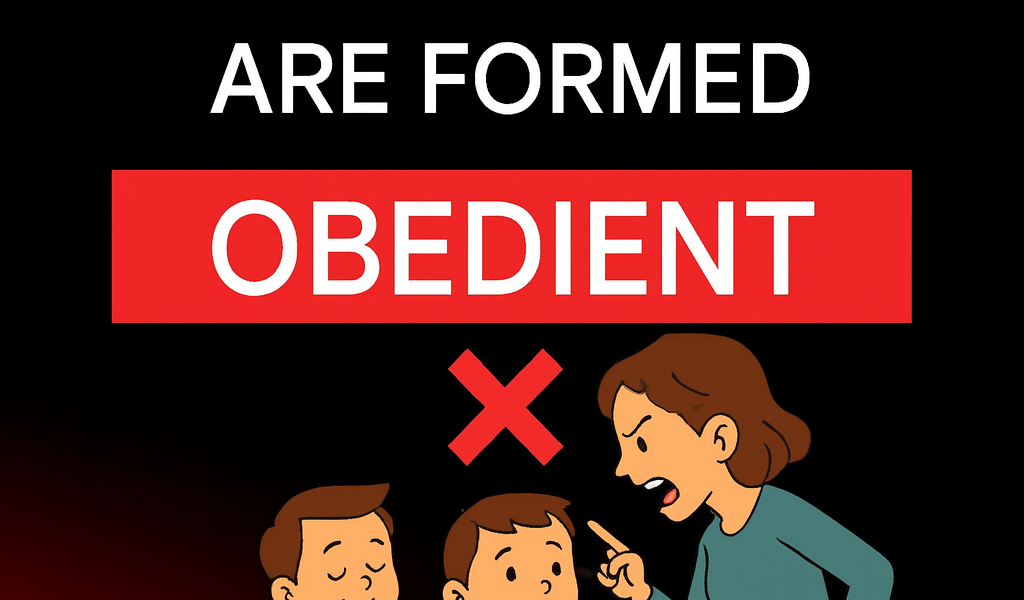
The secret to your child always paying attention to you.
Do you feel like you’re talking and your kids “turn off” like they have a mute button? You repeat the same thing a thousand times, you end up screaming, then you feel guilty and wonder what you’re doing wrong. You’re not alone. The good news is that it’s not about being a “perfect parent,” it’s about understanding how your child’s brain works… and yours.
Why Screaming Doesn’t Work (Even If It Seems Like It Does)
When you scream, your child’s brain interprets your voice as a threat. Your emotional system kicks in, releases cortisol and adrenaline, and goes into survival mode: fight, flight, or block. In that state, the rational part of the brain—the one that helps think, reflect, and learn—becomes “switched off.”
That is why he sometimes obeys immediately, but not out of respect, but out of fear. He doesn’t understand what he did wrong, he just wants the “danger” to go away. In addition, each shout leaves an emotional imprint: your child doesn’t just remember the command, he remembers how he felt about you at that moment.
Your child’s brain is under construction
Unlike the adult, the infant brain is still maturing. The area that helps plan, control impulses, and understand consequences (prefrontal cortex) takes years to fully develop.
Therefore:
- Young children live in the “here and now.”
- They find it difficult to anticipate the future: “if you don’t pick up now, then we don’t see drawings” it makes almost no sense to them.
- His working memory is limited: if you give him five instructions in a row, he’ll stick with one or two.
- Impulse often wins out over the norm: she knows not to touch the vase, but curiosity is more powerful.
It’s not that he “doesn’t respect you”; Many times, your brain just can’t take it anymore.
Connection before correction
A child cooperates best when he or she feels connected, seen, and loved. Before giving an order, look to connect:
- Get at his physical level, look him in the eye.
- Name it calmly: “Matthew… look at me for a moment.”
- He validates what he’s doing: “I see you’re very focused with your blocks, it’s looking great on you.”
Only afterwards, does he give the instruction clearly:
“In five minutes we are going to put away the toys for dinner. Do you want us to do it together or do you prefer to do it by yourself?”
You gave him notice, options and a team feeling. That lowers their defense and opens the door to cooperation.
How to Give Commands Your Brain Can Obey
Some practical keys:
- On the positive side: instead of “don’t run”, try “walk slowly”; instead of “don’t shout”, “speak softly”. The brain has a better understanding of what it should do.
- Specific and concrete: “behave well” is very vague; “Sit in the chair with your feet on the floor and your hands on the table” is clear.
- One at a time: especially in young children. First: “go to the bathroom and wash your hands.” When he does, only then do you give the next instruction.
- With his full attention: no shouting from the other room. Go to where he is, look for his gaze and make sure he heard.
And when he obeys, reinforce immediately:
“Thank you for picking up the toys when I asked you, that helps a lot at home.”
Firm boundaries, but with respect
Educating without shouting does NOT mean educating without limits. Children need structure to feel safe. The key is gentle firmness:
- Validate the emotion: “I understand that you love sweets…”
- Marking the limit: “… but we’re going to eat them after dinner.”
- Offer an option within the frame: “Will you start with the chicken or the salad?”
Without humiliating, without exaggerated threats, but without giving in to every tantrum. Consistency gives them security: they know what to expect from you.
It all starts with you: your emotional regulation
Your child learns more from what they see than from what they hear. If you explode, scream or lose control in the face of any problem, that is the model that sticks with it.
Some tools for you:
- Pause before reacting: take a deep breath, count to five.
- Change the internal dialogue from “I can’t take it anymore” to “I’m the adult, I can handle this”.
- Take care of the basics: rest, food and small moments for yourself. An exhausted adult has very little patience available.
Making mistakes does not make you a bad father or mother. The important thing is to make amends:
“I yelled at you before, and it wasn’t right. I am sorry. I’m going to try to talk to you more calmly next time.”
That also educates.
Tips and recommendations
- Spend at least 5 minutes a day with each child alone, without screens, doing something that he chooses.
- Establish clear routines (morning, afternoon, night) to reduce fights and arguments.
- Use play and humor for difficult tasks: races to get dressed, “catching sugar bugs” when brushing their teeth, etc.
- Check before you get angry: are they hungry, sleepy, over-energetic, or do they need attention?
- Agree on logical and proportional consequences, without humiliating or frightening.
- Ask for professional help if, even if you make changes consistently, you feel that the situation is beyond you.
Getting your child to always listen to you is not about controlling them, but about understanding how their brain works, building connection and calmly maintaining clear boundaries. You don’t need to be perfect: you need to be mindful, consistent, and willing to improve a little bit every day. From a firm and unconditional love, obedience ceases to be fear… and it becomes collaboration and mutual respect.
👉 Follow our page, like 👍, and share this post. Every click can make a difference—perhaps saving your own life or that of a loved one.