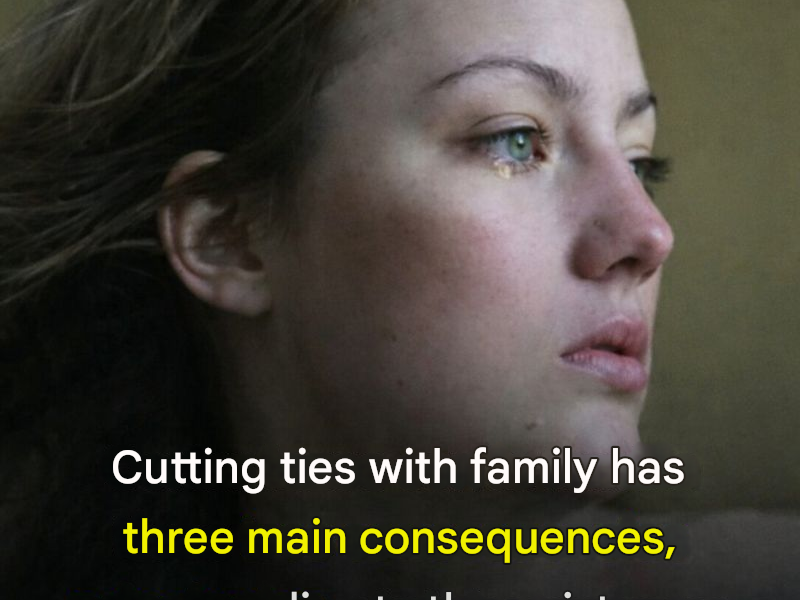
Cutting Family Ties Can Have Unexpected Consequences

Moving away from family is never a light or impulsive decision. In most cases, it arises after years of confusion, emotional exhaustion, and a deep need to regain inner balance. Taking distance can offer relief, but it also triggers lasting effects that transform everyday life in ways that many people don’t anticipate. Understanding these impacts is key to healing and protecting mental well-being.
Creating distance as an act of self-preservation
Contrary to popular belief, breaking or reducing family contact is rarely a whim. As therapist Alice Zic explains, in many cases it is a form of emotional self-defense. When family interactions become a constant source of stress, conflict or exhaustion, distance appears as the only way to survive psychologically.
For many people, this step is the last resort after trying, unsuccessfully, to dialogue, to set boundaries or to seek understanding. Moving away allows you to stop, breathe, and reconnect with yourself after having held an excessive emotional load for too long.
Relief Mixed with Pain: An Emotional Contradiction
One of the most disconcerting effects of cutting family ties is the coexistence of opposing emotions. On the one hand, immediate relief usually appears: tension decreases, anxious thoughts are reduced, and everyday life can feel lighter and safer. It’s as if the constant need to be on guard finally disappears.
However, this calm almost always coexists with a deep sadness. Not only is what happened mourned, but also what could never have been: the family relationship desired, imagined or expected. That pain does not always manifest itself in an obvious way; Sometimes it remains as a persistent background that, over time, softens, although it rarely disappears completely.
Social pressure and the weight of expectations
Internal conflict is often intensified by external judgment. In many cultures, family is seen as a sacred and unquestionable bond, and choosing distance can lead to criticism, misunderstanding, or rejection. Specialist Patricia Dixon points out that these social expectations can deepen discomfort, forcing people to justify over and over again a decision made to protect their emotional health.
In contexts where intergenerational loyalty is valued in an extreme way, guilt can become especially intense. Thus, many people are caught between the relief of feeling emotionally safe and the fear of disappointing others, a silent exhaustion that takes time, patience and self-compassion to resolve.
Rebuilding the emotional foundation
With the passage of time, one of the most significant transformations appears: redefining what “family” really means. With the disappearance of traditional pillars, space opens up to build new support systems. Close friends, partners, mentors, or colleagues can become a chosen family, based on respect, trust, and mutual care.
Specialists recommend seeking support during this process. Therapy or group spaces help process emotions, strengthen boundaries and regain personal confidence. Psychologist Joshua Coleman stresses the importance of knowing one’s own limits and needs, especially if at some point a possible reconnection is contemplated.
Healing at your own pace, surrounded by people who provide genuine support, can transform a painful separation into a profound opportunity for growth, clarity, and self-understanding. On this path, choosing to take care of oneself is not an act of selfishness, but a necessary form of self-respect.
👉 Follow our page, like 👍, and share this post. Every click can make a difference—perhaps saving your own life or that of a loved one.