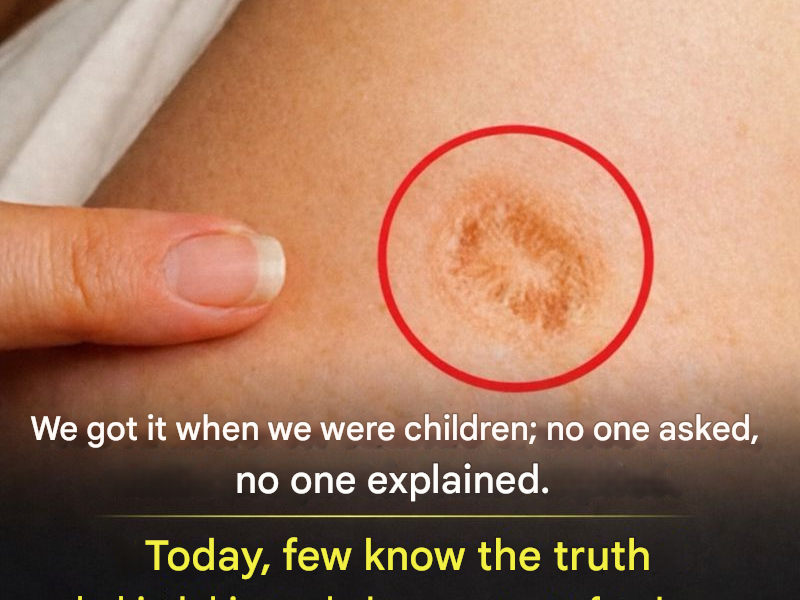
Five misconceptions about the round scar on the upper arm

In many countries in Asia, Africa, Latin America, and Eastern Europe, millions of people share a small round mark on their upper arm. Some discover it only as adults and wonder why it is there. Others feel uncomfortable with it, or even invent explanations because no one ever told them the truth.
That small scar has been the cause of rumors, shame, and confusion for decades. However, its origin is much simpler and more positive than many imagine.
Below, we debunk five of the most common myths about this brand and reveal what it really means.
Myth 1: “It’s a skin disease or childhood injury”
Many people believe that this mark is the result of a skin infection, a poorly healed wound, or even an old burn.
The truth
In the vast majority of cases, that scar comes from the BCG vaccine, used to protect against tuberculosis. This vaccine is usually given in childhood, so most people do not remember receiving it.
The mark appears as part of the immune system’s natural response to the vaccine. It is not a sign that something went wrong, but quite the opposite: it indicates that the body reacted as it should.
Myth 2: “Only people from poor or rural backgrounds have it”
This myth is fraught with prejudice. There are those who associate the scar with poverty, poor hygiene or lack of medical care.
The truth
The BCG vaccine was, and in many places still is, part of national vaccination programs. It was applied to millions of children from all walks of life, especially in countries where tuberculosis was a major threat.
Having this scar doesn’t say anything about your background, education, or economic status. It is a sign of a public health policy, not of a social condition.
Myth 3: “If you don’t have the scar, then you weren’t vaccinated”
Comparing arms became a kind of informal “test” for some: if there is no brand, it is assumed that there was no vaccine.
The truth
Not everyone develops a visible scar after receiving BCG. In some cases, the skin scars almost without a trace. In others, the mark becomes very dim over the years.
The absence of a scar does not mean that you have not been vaccinated, in the same way that having a scar does not indicate greater or lesser protection.
Myth 4: “The scar indicates that your immune system is weak”
Some people fear that the mark is a sign of damage or weakness in their defenses.
The truth
The scar is actually a sign that the immune system responded to the vaccine. It represents a localized reaction of the body when it recognizes the weakened microorganisms of BCG.
Far from being a negative thing, this reaction is part of early immune system training. The scar does not cause problems or affect long-term health.
Myth 5: “It’s dangerous or it should be eliminated”
For cosmetic reasons or out of fear, some people believe that the scar is something abnormal that should be treated.
The truth
The BCG scar is completely harmless. It does not grow, it does not spread, and it does not transform into any disease. From a medical point of view, there is no need to remove it, unless someone wants it for purely aesthetic reasons.
For health professionals, it’s simply a benign mark, a silent reminder of early protection.
A small scar with a big story
For many people, this mark is a reflection of a time when medical decisions were made without much explanation. Parents trusted the health systems and children were protected, although they rarely knew why.
Today, understanding the true origin of this scar helps eliminate shame, fear and misinformation. It is not a defect or a sign of disease. It is, simply, a trace of preventive medicine.
Sometimes, the smallest brands keep the most important stories.
👉 Follow our page, like 👍, and share this post. Every click can make a difference—perhaps saving your own life or that of a loved one.