
How to fall back asleep quickly during the night as you age.
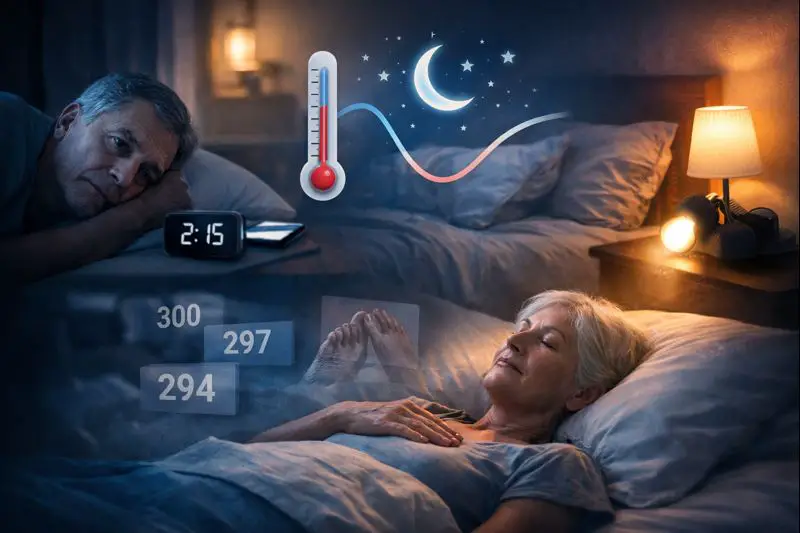
Waking up in the middle of the night becomes more and more common over the years. Many older people wake up between 1 and 3 a.m. and, although they manage to fall asleep without problems at first, they find it difficult to fall back asleep later. This is not always a disease, but it can affect the quality of rest and energy during the day.
Understanding why it happens and what to do in those moments can make a big difference.
Why Do We Wake Up More in the Early Morning as We Get Older?
When you fall asleep, your body’s core temperature slowly rises until around 10:30 p.m. Then it begins to descend, and that drop is the signal that the brain uses to release melatonin, the hormone that facilitates deep sleep.
However, at some point in the night, that temperature rises slightly again. This usually happens between 1 and 3 a.m. As we age, we spend less time in deep sleep, so these thermal variations can lead to more frequent awakenings and lighter sleep.
What You Should Avoid When You Wake Up at Night
Many times, the problem is not waking up, but what we do afterwards.
1. Look at the clock
Seeing the time activates the mind immediately. You start calculating how much you have left to sleep, you get anxious and the body goes into a state of alert. That anxiety raises your heart rate, and to get back to sleep you need your heart to be calm.
2. Use the cell phone
The light from the screen stimulates the brain, even at low brightness. In addition, checking notifications increases mental activity and raises your heart rate, just the opposite of what you need to sleep.
3. Get up “just in case” to the bathroom
If you really need to go, go for it. But many people get up just because of doubt. Going from lying down to walking raises your pulse and makes it harder to return to sleep. It is advisable to evaluate whether it is really necessary before getting up.
4. Turn on strong lights
Artificial light disrupts the circadian rhythm and signals the body to be awake. If you need to get up, use a dim light or a small night light to minimize the impact.
Effective Techniques to Get Back to Sleep
If you’ve avoided all of the above and you’re still awake, these techniques can help.
4-7-8 Breathing
It is a simple and very effective technique to reduce the heart rate.
- Inhale gently for 4 seconds
- Hold the air for 7 seconds
- Exhale slowly for 8 seconds
Don’t force your breath. The goal is for the body to relax and the heart to slow down, making it easier to return to sleep.
Count backwards from 300
Close your eyes and start counting from 300, subtracting from threes: 300, 297, 294, 291…
This exercise distracts the mind, avoids repetitive thoughts, and helps to “turn off” mental noise. Many people use it after deep breathing.
Progressive Muscle Relaxation
It consists of tensing and relaxing muscle groups gradually.
Start with the feet:
- Tense your muscles for a few seconds
- Let go and feel the difference
Then it goes up to calves, thighs, abdomen, arms, shoulders and neck, until it reaches the head. This method helps to release physical tensions that often prevent rest without us noticing.
The Value of Deep Sleep Without Sleep
There is a state called deep sleep without sleep. Even if you are not asleep, if you lie in the dark, breathing slowly and with your body relaxed, your body continues to recover energy.
Approximately one hour of this rest is equivalent to about 20 minutes of restful sleep. Knowing this reduces anxiety and prevents the fear of “not sleeping” from making the situation worse.
Final Tips and Recommendations
- Keep the bedroom dark, quiet and cool
- Avoid stimulating drinks in the afternoon
- Have water nearby so you don’t get up unnecessarily
- Set regular times for sleeping and waking up
- If you wake up frequently tired or snore, consider a medical sleep evaluation
Waking up in the wee hours of the morning doesn’t mean something is wrong. Many times it is a natural response of the body with age. The key is not to activate the mind or body when it happens. Learning to calm your breathing, relax your muscles, and accept rest, even without sleep, can completely transform your nights.
👉 Follow our page, like 👍, and share this post. Every click can make a difference—perhaps saving your own life or that of a loved one.