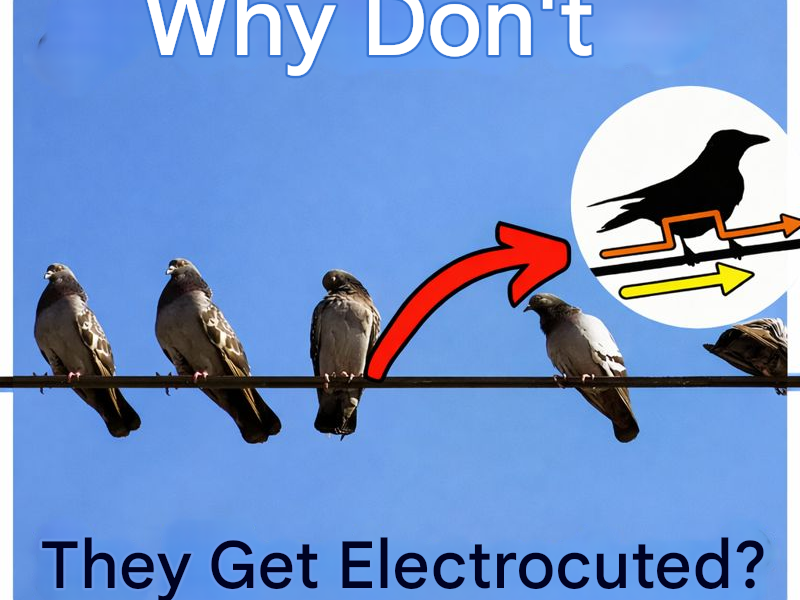
Why birds don’t get electrocuted when perching on high-voltage wires.
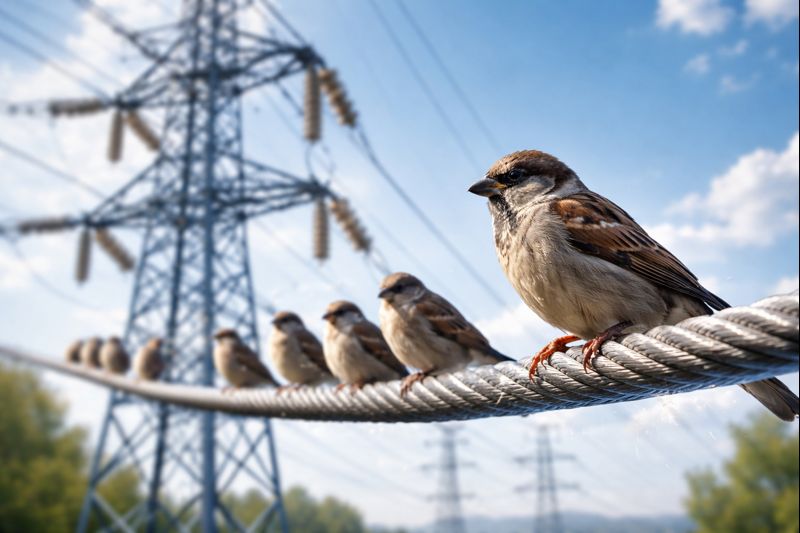
You’ve probably seen it more than once: a row of birds perched quietly on high-voltage cables, as if nothing was happening. Below, millions of volts circulating; above, small birds resting without the slightest damage. The scene seems like a direct challenge to common sense. How can something so fragile survive where a human would die in seconds?
The answer is not magical or lucky. Nor are they about animal superpowers. It is pure physics, a combination of invisible laws that govern the behavior of electricity and that, when understood, explain this phenomenon in a clear and surprising way.
Electricity doesn’t “attack”: it just wants to flow
We tend to think of electricity as an aggressive force, ready to strike down anything that comes close. It’s actually much simpler and more predictable. Electricity does not seek to destroy, it seeks to move. And to do so it needs something fundamental: a closed circuit.
A good way to understand it is to think of water inside a pipe. The water may be at enormous pressure, but if there is no outlet, it does not flow. The same happens with electricity: although the voltage is very high, if it does not have a complete path to go from one point to another, it does not circulate.
High-voltage cables are perfect highways for electrons. They are made of materials such as copper or aluminum, which offer very little resistance. Current travels through them efficiently and continuously.
The path of least resistance
Here comes the first key principle: electricity always chooses the easiest path.
When a bird perches on a single wire and rests both legs on the same conductor, the current has two options:
- Continue along the metal cable, wide and extremely conductive.
- Deviate, go through the bird’s body and return to the cable.
The body of a living being, even that of a bird, is a terrible conductor compared to metal. For electricity, traversing fabrics is like trying to walk through a swamp when there is an asphalt highway next to it. Out of sheer efficiency, the current ignores the bird and continues its way down the wire.
The real secret: voltage and “floating potential”
But there’s something even more important than resistance: the potential difference, what we commonly call voltage.
For electricity to do harm, it must pass through a body. And for that to happen, there has to be an energy gap, like a waterfall. No fall, no movement.
When a bird perches on a single wire, its entire body is at the same voltage as the wire. If the wire is at 10,000 volts, the bird’s two legs, body, and beak are also at 10,000 volts. There is no difference in potential within your body. There is no “cascade” through which electrons can flow.
This state is known as floating potential. The bird does not block electricity: it simply “floats” on it, becoming another extension of the cable.
So why can’t humans do it?
The difference is not in the body, but in the connection with the ground.
The soil has a potential close to 0 volts. It is, to put it simply, the great drain of electricity. Humans are almost always in contact with it, directly or indirectly.
If a person touches a high-tension cable while their feet are on the ground, it becomes the perfect bridge between a point of very high energy and another of zero energy. The current does not ignore it: it crosses it violently to unload, with fatal consequences.
Birds survive because the air completely isolates them from the ground.
Size does matter: pitch tension
There is another crucial factor called step tension. Even though a wire has a constant voltage, there are actually small potential differences along its length.
The birds’ legs are very close together, so the difference in voltage between one and the other is minimal, practically zero. In large animals, or in humans, this changes.
If a power line falls to the ground, the electricity is scattered throughout the earth. A person walking nearby may have one foot in a higher voltage area and the other in a lower voltage area. This difference causes the current to go up one leg and down the other, electrocuting her without touching the cable.
The compact size of the birds is, in this sense, a vital advantage.
When birds are in danger
This system is not foolproof. Birds are electrocuted to death when they break the fundamental rule: touch two points with different potential at the same time.
This is especially true for large birds, such as eagles or owls. When taking off or landing, their large wingspan can cause them to touch two different cables, or a cable and a grounded metal structure. In that instant, your body becomes the only bridge between two different energy levels. The download is immediate.
For this reason, many modern electrical installations incorporate special insulators and designs to reduce this risk.
When humans imitate birds
Interestingly, this same principle is used by people who work in active power line maintenance. In certain cases, the power cannot be cut off, so operators must work with the energized line.
To do so, they are completely isolated from the ground, even using helicopters. In addition, they wear special driver suits that function as a Faraday cage. Upon contact with the wire, your entire body is brought to the same electrical potential. The current flows across the surface of the suit, surrounding them without passing through them, just as a bird does on a wire.
Tips and recommendations
- Never try to imitate this phenomenon: even if you understand it, electricity does not forgive mistakes.
- If you see a cable lying on the ground, walk away without taking long steps; Keep your feet together and step back in short strokes.
- Remember that the electrical hazard does not depend only on the voltage, but on the difference in potential and your contact with the ground.
- Teaching these basic principles can save lives, especially in rural areas or during storms.
Birds do not survive by luck or immunity, but because they respect—without knowing it—the fundamental laws of physics. Electricity does not attack randomly: it flows according to precise rules. Understanding them reminds us that the real danger is not always in the strength of a threat, but in our position in the face of it.
👉 Follow our page, like 👍, and share this post. Every click can make a difference—perhaps saving your own life or that of a loved one.