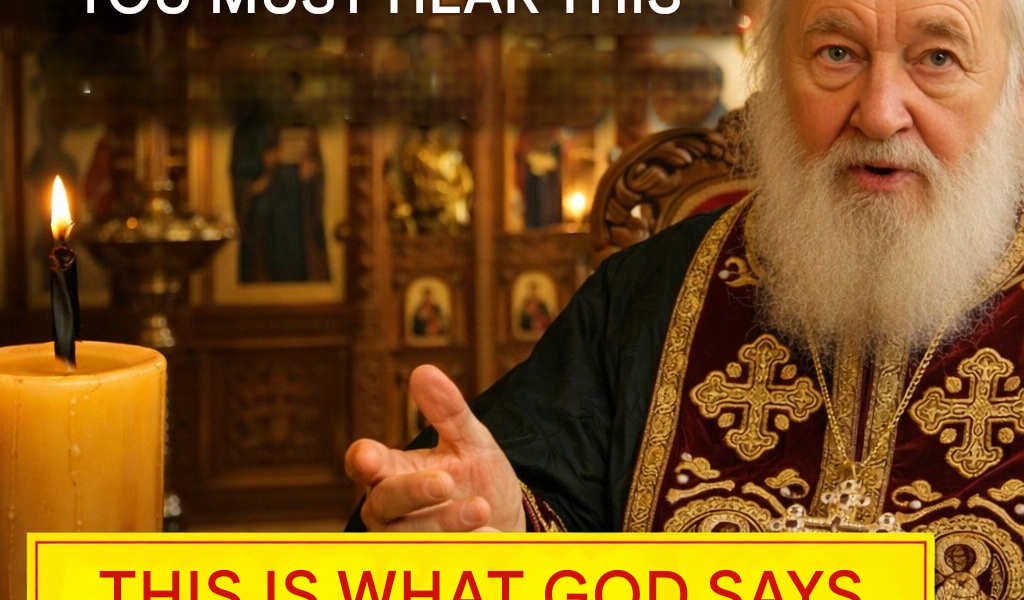
Believers over 60: a spiritual reflection on the last years of life according to faith.

Many people, in their 60s or 70s, are asked a silent question: “What now? Am I still good for something? Does God still care about me?”
It’s not always said out loud, but it is felt. You can see it in the tired look, in the way he speaks more slowly, in that sigh that appears when the children have already made their lives and the body no longer responds as before.
And yet, there is one truth that completely changes the way we look at this stage: for God, no one becomes “unnecessary” over the years. On the contrary: the last years can become the deepest, most conscious and most valuable stretch of the spiritual path.
The most dangerous lie of old age: “I’m no longer important”
In old age, it is not only the knees or the back that hurt. It can also hurt your heart inside.
That bitter feeling of “surplus” appears: you no longer work, the routine changes, the phone rings less, and the world seems to go too fast.
But that idea that “I am no longer useful” is not born of God. It is a lie that extinguishes hope, because it pushes the person to close themselves, to resign themselves, to live as if their story no longer had a purpose.
The reality is different: as long as there is life, there is meaning. While the heart beats, there is still a place for love, for reconciliation, for faith, for prayer, for peace that is learned late… but you learn.
The Silent Value of Prayer at This Stage
There is a very particular strength in the prayer of an older person.
It’s not always long, it’s not always perfect, sometimes it’s simple phrases, repeated in a low voice, almost like a sigh. But that is precisely where its beauty lies: it is a prayer that is born of experience, of pain, of memory, of love for children and grandchildren.
Many times, the one who supports a family the most is not the one who speaks the most, but the one who prays the most.
Even if no one sees it. Even if no one applauds it. Even if it seems “little”.
That humble fidelity — day after day — has enormous value, because it is a form of constant love.
The last few years are not “an end”, they are a decisive part
When we are young, life is usually full of noise: work, goals, urgencies, worries, pride, haste.
And in the midst of all that, sometimes there is no space to look inside.
But after the age of 60 comes something different: time to think, to order the heart, to look at life with truth.
It’s like the last pages of a book: they’re not a “filler,” they’re what gives meaning to the whole story.
This stage can be a “spiritual autumn”:
- for some, a time of complaints, bitterness and sadness;
- for others, a time of maturity, gratitude and inner peace.
It does not depend on the strength of the body. It depends on the direction of the heart.
“I ruined a lot of things… can I still change?”
This is another common wound: guilt.
Many older people carry hard memories: wrong decisions, words that hurt, stages of distance from faith, mistakes in the family, unhealed wounds.
But there is a liberating truth: you can’t always change the past, but you can change your heart.
And when the heart changes, the past ceases to be a condemnation and becomes a lesson given to God.
Old age can be the time when, for the first time, one is encouraged to see honestly what one avoided for years. Not to sink, but to heal. Not to punish each other, but to reconcile.
Four temptations that strike hard after 60
There are inner battles that become more intense at this stage. Recognizing them helps to avoid falling into them.
1) Feeling worthless and falling into sadness
The person is measured by what he “produces”, by what he “does”, by his performance.
But the value of a life is not reduced to working or earning money.
At this age, there are immense gifts: patience, memory, experience, ability to sustain others with simple words… and deeper prayer.
2) Hardening the heart with resentments
When someone feels that they “gave everything” and “received little,” the heart hardens.
And that harshness does not punish others first: it punishes those who carry it.
Forgiveness is not always justifying. To forgive is to release the poison so that the soul does not get sick. That is, “I don’t want to live the rest of my life stuck in this.”
3) Fear of death
In youth, death seems distant; after 60 it becomes real.
And fear can push you to avoid the subject, fill the silence with noise, distract yourself so as not to think.
But faith proposes another perspective: not to deny fear, but to learn to trust.
Like a son who enters a dark place when someone takes him by the hand.
4) Spiritual laziness disguised as “I’m already grown”
Sometimes the idea appears: “I’ve prayed enough”, “I’ve done enough”, “I can’t do it anymore”.
It’s true: the forces are going down. But the inner life does not retire.
The important thing is not to do “a lot”. It is to keep the bond alive: a short prayer, a word of gratitude, a gesture of kindness, a moment of silence with God.
What is best to leave as a legacy: forgiveness and peace
Many think of inheritance as a house, money, objects.
But there is a stronger heritage: the peace with which one lives.
A mother or father who chooses not to live in reproach leaves an enormous legacy.
A grandfather who blesses instead of controlling leaves a luminous memory.
Sometimes a single sincere phrase changes a generation:
“I love you. I forgive you. I pray for you. I am at peace.”
I don’t “take my last steps”: I’m maturing inside
There are two ways to say it:
- “I’m hurting and waiting for it to end.”
- “I’m maturing for the eternal.”
The second does not deny pain, loneliness, or diseases.
Only the inner posture changes: “I am not a nuisance. I still have a purpose. I can still love. I can still heal. I can still trust.”
Tips and practical recommendations for this stage
- Do a short prayer every day, even if it’s 30 seconds. Consistency is worth more than perfection.
- Name your loved ones in your prayer, even if you’re angry with one. That softens the heart.
- Find a habit of gratitude: every night, think of just one thing you can be thankful for (a call, a meal, a memory, another day).
- Let go of a specific resentment: choose one and start working on it patiently. Sometimes forgiveness is a process, not a button.
- Don’t isolate yourself out of pride: asking for company or help is not weakness; it is humanity.
- Take care of your health without making it the center of your life: follow medical indications, but don’t live only for tests.
- Leave a good word every day: to a family member, to a neighbor, to someone on the street. That gives you meaning back.
- Avoid feeding complaints: it is not about feigning joy, but about not living trapped in bitterness.
The last years are not “the waste” of life: they can be the truest stage, when the soul learns to let go of what is heavy, to forgive what hardens and to trust with humility.
It is not time to “last”. It is time to mature, with peace, with faith and with love.
👉 Follow our page, like 👍, and share this post. Every click can make a difference—perhaps saving your own life or that of a loved one.