3 Spiritual Interpretations About Crying During Mass and Its Meaning.
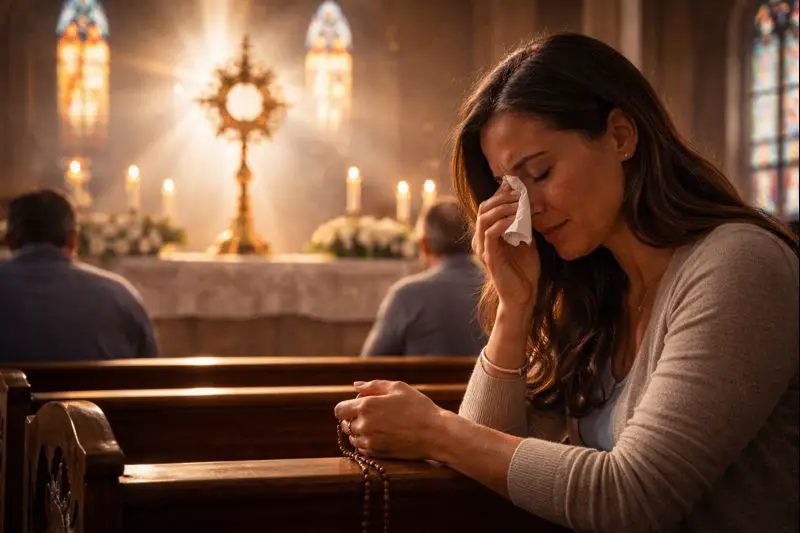
Sometimes it happens like this: you are at Mass, everything seems normal, the silence becomes deep, and suddenly your eyes fill with tears. It is not a scandalous cry; It can be just a shy wetness, or an emotion that rises from the chest and surprises you in front of the altar. And immediately comes the doubt: “What’s wrong with me?”, “Am I getting sensitive?”, “Am I exaggerating?”.
But there are tears that are not born of fatigue or a specific problem. There are tears that appear when the soul reacts to something that the mind does not yet know how to explain. In faith, the heart also speaks. And sometimes their language is crying.
Below, you will find three spiritual meanings that may be behind that moment.
1) Inner recognition: the soul perceives a Presence
There is a type of crying that does not come from sadness, but from an encounter. It is when something inside you “recognizes” that you are in front of the sacred, even though you have no words to describe it.
At Mass there are moments where the heart is left without defenses. The person may be used to controlling everything in life: supporting others, not collapsing, maintaining an image of strength. But in front of God, that “suit” weighs heavily. And when the heart stops acting, sometimes it cries.
These tears usually feel like this:
- They arrive for no clear mental reason
- bring a lump in the throat and a sense of truth
- They leave no shame inside, but a mixture of wonder and humility
It’s not that you “lost control.” It may be that, for a moment, you stopped hiding.
2) Silent healing: an inner wound opens to mercy
Another possibility is that this crying is the beginning of a deep healing, even in areas that had been closed for years.
There are pains that one learns to keep so well that one no longer registers them: old guilts, losses not mourned, words never spoken, spiritual weariness, wounds of rejection, exhaustion from holding too long. And sometimes, Mass becomes the only place where the soul feels safe enough to slacken.
These tears don’t always “explain” their motive, but they do leave signs:
- After the crying there is a soft peace, as if something had been discharged
- you feel lighter inside, even though you are sensitive
- It’s not euphoria: it’s inner rest
Spiritual healing is not always noisy. Many times it is a process: one layer is released today, another the next time, and so the heart breathes again.
3) Intercession: Tears That Aren’t Just for You
There is a more delicate mystery: crying without knowing why, but feeling that the crying is “bigger” than your own story. Sometimes, the person finds himself thinking about others: a child, a relative, someone who suffers, someone who has moved away, even strangers.
That weeping can be experienced as intercession, a form of silent prayer: it is not a matter of talking a lot, but of offering the heart as a bridge.
It is recognized because:
- Crying appears even if “you’re not bad”
- You feel deep compassion, as if you carry something for someone else
- At the end, there is a strange tiredness, but with peace
This doesn’t make you “more” than anyone else. It just shows that your sensitivity can become a discreet form of prayer.
How to live these tears without getting confused
When they appear, there are three simple movements that help a lot:
- Welcome: do not fight with the moment, do not cover it with shame.
- Unite: in silence, turn your heart to God: “I am here”.
- Offer: give it inner meaning: “Receive this as prayer.”
There is no need to dramatize or seek to repeat it. There are days of tears and days of silence. The important thing is not to cry, but to keep your heart available.
Tips and recommendations
- Do not judge yourself: crying is not a lack of faith; Many times it is a sign that your inner self is alive.
- Don’t compare yourself: each person experiences the Mass differently; some feel more, some less, and both ways can be authentic.
- Don’t repress it out of shame: if you need to dry yourself, do it calmly, without punishing yourself.
- Give it a brief intention: if you want, repeat a simple phrase inside: “Receive my tears as a prayer.”
- Discern by the fruit: if after the cry there is peace and recollection, it is usually a good sign. If there is agitation, you can accompany it later with quiet prayer.
- If crying is very frequent and overwhelms you (to the point of preventing you from living Mass or your daily life), seek support: talking to a spiritual guide or a professional can also be part of caring for the soul.
If you ever cried at Mass, don’t take it as a mistake. It can be recognition, healing, or intercession—three ways the heart responds when the sacred touches the deep. You don’t need to explain everything. Sometimes, the truest is not said in words, but in tears offered in silence.