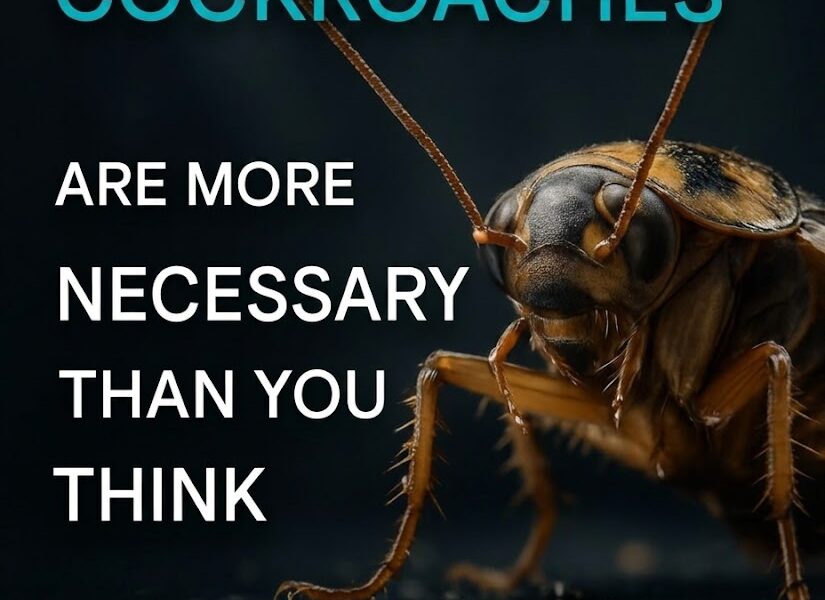
Why cockroaches are so hard to eradicate and what would happen if they disappeared from the planet
Few animals generate as much rejection as cockroaches, and at the same time, few arouse as much fascination among biologists, entomologists and medical specialists. These insects have been walking the Earth for more than 300 million years, survived five mass extinctions, saw dinosaurs appear and disappear and today continue to inhabit almost every corner of the planet, including the cleanest homes. The question is inevitable: why is it so difficult to eliminate them and what would happen if we managed to exterminate them completely?
An evolutionary story of survival
Cockroaches belong to the order Blattodea and represent one of the oldest groups of insects in the fossil record. Their success is no coincidence: for hundreds of millions of years they perfected a set of adaptations that turned them into machines of resistance. While other species specialized and were tied to specific environments, cockroaches remained generalists, capable of eating practically any organic matter, from food scraps to cardboard, glue or hair.
Only a few of the more than 4,500 known species are considered household pests. Most live in forests, caves and tropical areas, where they fulfill important ecological functions. However, species such as Blattella germanica and Periplaneta americana adapted so well to human environments that they became virtually inseparable from our cities.
Why insecticides lose effectiveness
One of the most studied findings in recent decades is the speed with which cockroaches develop resistance to chemicals designed to eliminate them. Research published in peer-reviewed journals showed that some populations can become immune to several insecticides in a single generation, even to products to which they were never directly exposed. This phenomenon is known as cross-resistance.
The reason lies in their biology: they have short reproductive cycles, produce many offspring, and possess enormous genetic variability. When a poison kills 95% of the population, the remaining 5% transmits the resistant genes to the next generation, which grows free of competition and multiplies the problem.
Other biological defenses
- Rugged exoskeleton: withstands pressures equivalent to 900 times their own weight, allowing them to escape through minimal cracks and withstand shocks.
- Decentralized nervous system: they can survive about a week without a head, since they breathe through holes distributed in the body and only die from lack of water.
- Accelerated reproduction: a female can produce hundreds of offspring in a few months.
- Flexible feeding: They survive on minimal amounts of food and withstand long periods of fasting.
Unexpected allies of medicine
Although it sounds paradoxical, cockroaches could help save human lives. Studies carried out at universities in the United Kingdom and China identified antimicrobial peptides in their brain and tissues capable of eliminating bacteria resistant to conventional antibiotics, including hospital strains such as methicillin-resistant Staphylococcus aureus (MRSA) and Escherichia coli.
Their immune system, adapted to environments laden with microorganisms, produces compounds that pharmaceutical science is studying to design next-generation antibiotics. In a world where antimicrobial resistance is one of the main health threats, this line of research is becoming increasingly relevant.
What would happen if all cockroaches disappeared
The idea of a planet without cockroaches may sound appealing, but the ecological consequences would be more complex than it seems. In natural ecosystems, these insects fulfill fundamental functions:
- Decomposition of organic matter: they recycle fallen leaves, decaying wood and animal remains, returning nutrients to the soil.
- Link in the food chain: they are essential food for birds, reptiles, amphibians, arachnids and small mammals.
- Nitrogen input: when processing plant matter, they release nitrogenous compounds that enrich forest soils.
Their disappearance would especially affect tropical forests, where they play a key role in nutrient cycling. Many insectivorous bird species would lose an important food source, leading to cascading effects on larger predators and, eventually, on seed dispersal and plant regeneration.
Living with them, not eliminating them completely
Cockroach control in urban environments is still necessary for health reasons: they can transmit bacteria, contaminate food, and cause allergic reactions, especially in people with asthma. However, experts agree that the most effective strategy is not to exterminate them at any cost, but to apply integrated pest management: sealing cracks, eliminating sources of water and food, maintaining cleanliness and using insecticides in a timely and rotating manner to avoid resistance.
Cockroaches will surely continue to accompany humanity for a long time to come. Understanding their biology, rather than declaring them an unwinnable war, allows us to better control them at home while also valuing their role in nature and in the search for new medical treatments.