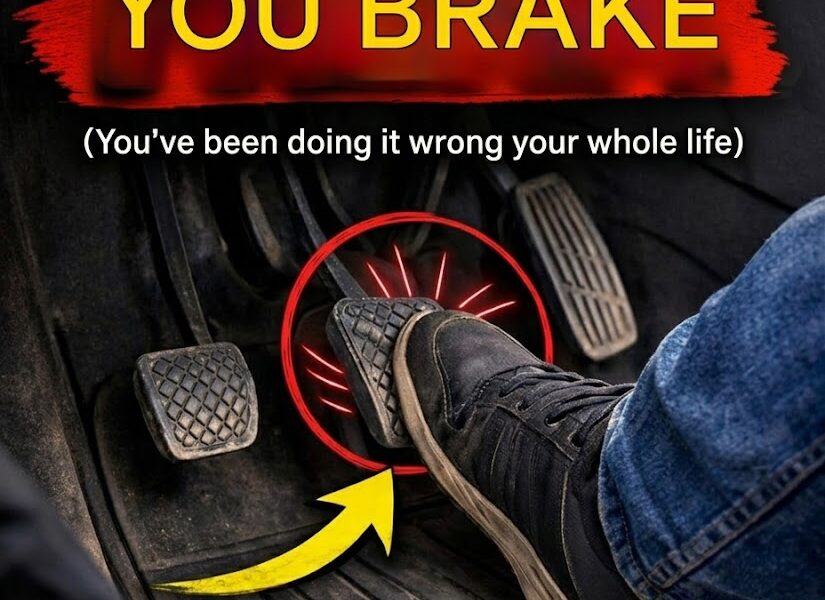
This is how a car must be braked correctly (many do it wrong without knowing it)
Braking a car seems like one of the simplest actions when driving. We all do it almost automatically, without thinking too much about how we are doing it. However, what many people don’t know is that a bad way of braking can seriously damage the braking system, affect the vehicle’s transmission and even put the safety of the driver and passengers at risk.
Many drivers repeat mistakes every day without realizing it. Over time, these habits can lead to premature wear, vibrations in the steering wheel, loss of braking efficiency and even very expensive repairs. That is why it is important to know what the most common mistakes are when braking and how to avoid them.
Below, you will learn about the most frequent mistakes made by millions of drivers and the correct way to brake to take care of your vehicle and drive more safely.
Mistake 1: Braking at the last second
This is one of the most common mistakes and also one of the most damaging to the brake system.
Many drivers maintain a high speed until the last moment and brake sharply just before stopping. Every time you do this, you force the brake discs and pads to absorb an enormous amount of energy in a very short amount of time.
This effort generates excess heat that can cause:
- Accelerated pad wear
- Crystallization of brake pads
- Deformation of the discs
- Vibrations when braking
- Loss of braking capacity
The right way to avoid this problem is to anticipate traffic and brake progressively. Slowing down gradually not only protects the braking system, but also improves driving safety.
Mistake 2: Keeping your foot on the brake
Many people drive with their foot lightly resting on the brake pedal without realizing it.
Even if the pedal is barely pressed, this habit causes the pads to be constantly rubbing against the discs, generating heat and unnecessary wear.
Among the problems this can cause are:
- Overheating of the brake system
- Premature wear of pads and discs
- Reduced braking efficiency
- Higher fuel consumption
This happens because the vehicle loses its natural inertia. The recommendation is to keep your foot away from the pedal when braking is not necessary.
Mistake 3: Going down slopes using only the brake
This is a very dangerous mistake that many people make, especially on mountain roads or long descents.
When you go down a hill using only the brake pedal, the system begins to accumulate large amounts of heat. If the heat exceeds certain levels, what is known as brake fatigue can occur, where the system loses much of its braking ability.
This can lead to extremely dangerous situations.
The correct way to go down slopes is to use the engine brake:
- In manual cars: downshift one gear
- In automatic cars: use hold or low gear modes
In this way, the motor helps to control the speed without overloading the brakes.
Mistake 4: Braking sharply after going through water
Few drivers know this detail.
If the brake discs are very hot and the vehicle passes through a deep puddle or an area with a lot of water, sudden cooling can cause deformation of the discs.
When discs become deformed, problems such as:
- Vibrations when braking
- Irregular wear
- Loss of smoothness when braking
After going through water, it is advisable to make small gentle braking for a few seconds. This helps to dry the brakes gradually and maintain their normal operation.
Mistake 5: Constantly moving forward and braking in traffic
In slow-moving traffic, many people have a habit of moving a few meters forward and braking constantly.
This driving style causes:
- Fast brake pad wear
- Higher fuel consumption
- Less efficient driving
A better way to drive in heavy traffic is to maintain a constant speed and take advantage of the vehicle’s inertia, moving smoothly instead of braking repeatedly.
Signs that you’re braking poorly
The car usually gives signals when the brake system is being misused.
Some of the most common symptoms are:
- Vibrations when braking
- Squealing or clanking noises
- Burning smell after driving
- Pedal too hard or too soft
- Increased distance to stop the vehicle
If you notice any of these signs, it is advisable to check the brake system as soon as possible.
Tips and recommendations
- Anticipate traffic and slow down early.
- Brake progressively, avoiding sudden braking.
- Use the engine brake on long descents.
- Don’t keep your foot on the brake pedal.
- After going through water, perform gentle braking to dry the brakes.
- Keep driving smooth in traffic.
- Periodically check pads, discs and brake fluid.
- Respect vehicle maintenance intervals.
Braking correctly is a more important skill than many drivers imagine. Small daily habits can make a big difference in vehicle wear and road safety. Driving early, smoothly and consciously not only protects the braking system, but also reduces unnecessary risks and costs.