How much wine should be served in the glass? The Golden Rule of the Sommelier Explained
Imagine the scene: you prepared a special dinner for your closest friends, soft music plays, the dishes give off irresistible aromas and you have just uncorked a bottle of excellent red wine. You take the glasses, lift the bottle and, suddenly, you are assailed by the doubt: how far should each glass be filled?
This question, which seems trivial, hides a fairly precise answer within the rules of good wine service. Let’s discuss four common ways to fill a cup to find out which one is right according to experts.
The four most common scenarios when serving wine
Before we reveal the answer, let’s look at what message each fill level conveys when we present it at the table.
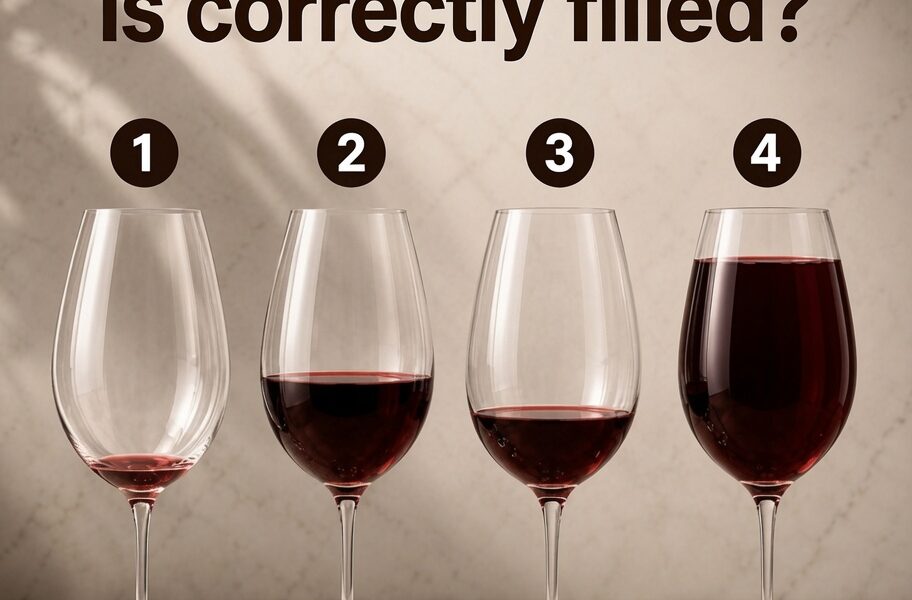
Option 1: Just a sip
The glass shows only a small amount of wine at the bottom. If you serve a guest like this, they might wonder if you’re running out of bottle or if they mistakenly entered a professional tasting with very strict rules.
Option 2: generous filling to the widest part
The wine reaches almost the widest area of the glass. It looks hearty, inviting, and seems perfect for a relaxed night out with friends.
Option 3: The Elegant Midpoint
There is a little more wine than in the first option, but much less than in the second. The level is just below the widest part of the crown. It looks refined, although it is worth wondering if it is really the ideal size.
Option 4: The overflowing glass
The wine reaches almost to the brim. It’s the style of someone who says “I had a heavy week”. He is certainly generous, but crossing the room with that glass over a light carpet becomes a test of balance. One wrong move and blemishes will be inevitable.
Why do wine glasses have such a particular shape?
To understand what the correct answer is, you first need to understand why wine glasses are designed with a wide base that closes upwards. It’s not just about aesthetics.
Wine needs to be oxygenated. When it comes into contact with air, oxygen interacts with the liquid and helps release its hidden aromas and nuances. This is especially important for reds, whose perfumes remained locked in the bottle for a long time.
In addition, wine aficionados often gently rotate the glass in circular motions. This gesture increases the contact surface between the wine and oxygen, allowing all its bouquet to unfold: fruity notes, wood, spices and many more.
Discarding the extremes
With this knowledge, let’s review the four options again.
If we fill the glass almost to the brim, as in option 4, there is no room left to swirl the wine. When you try to move it, it will end up spilling onto your clothes or tablecloth. Even worse: the aromas have nowhere to concentrate, so much of the sensory experience is lost. Option 4 is ruled out.
And option 1? It is true that there is plenty of space to shake the wine, but the amount is so small that, except in a professional tasting where dozens of labels are tested, the portion will heat up quickly to room temperature. It does not convey the feeling of enjoying a full glass.
Options 2 and 3 are then left. And here comes the key question.
Many people intuitively choose option 2 because the level seems balanced. However, we have to think again about the shape of the glass: the widest part of the cup is precisely the one that offers the greatest contact surface between the wine and the air.
The final verdict
So, what is the glass served correctly? The answer is option 3.
When wine is served just below the widest part of the chalice, we get two fundamental advantages at the same time.
- Maximum oxygenation surface: the wine has the largest possible surface area in contact with the air, which allows it to open completely and express all its aromas and flavors.
- Space to catch aromas: there is enough free space at the top of the glass, which works as an “aromatic trap” by retaining the perfumes right where the nose perceives them best during each sip.
It should be remembered that a standard serving of red wine is equivalent to approximately 150 milliliters, an amount that usually fills the glass to the level indicated in option 3.
Tip for the next time you serve wine
The next time you fill a glass, either for yourself or your guests, don’t give in to the temptation to serve to the brim. Give the wine the space it needs to breathe, swirl and release all its aromatic complexity. Serving less, in this case, is actually serving better.
A correct service not only demonstrates good taste and knowledge of etiquette, but also transforms each sip into a richer and more pleasant experience. Cheers!