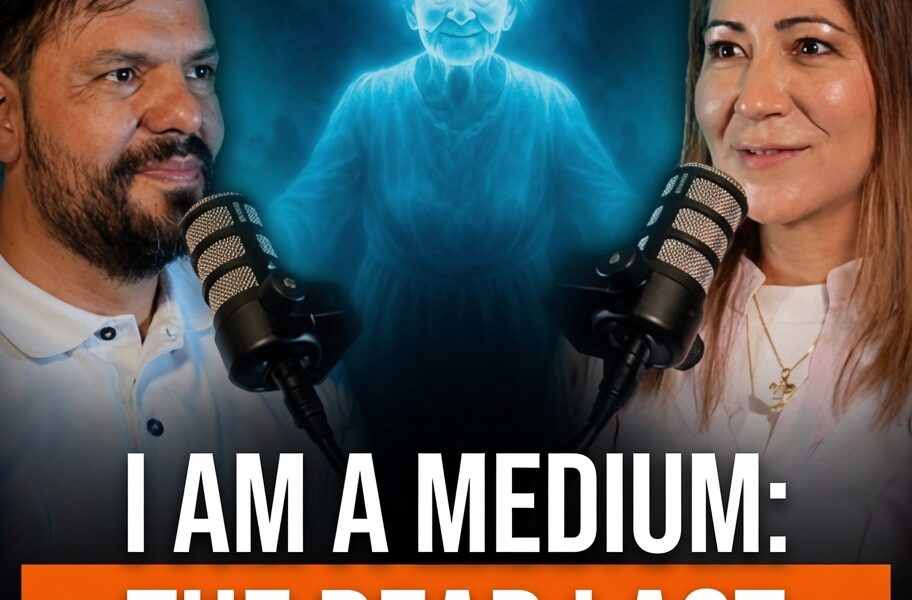
Reflections on spiritual communication and the symbolic meaning of grief according to different beliefs.
There are stories that are born in childhood and that, although we try to bury them under logic, come back again and again. In the case of Lis (a woman who claims to have mediumship), it all started when she was very young: “invisible friends” with whom she played as if they were a normal part of the house. For her they were not inventions or fantasies; they were presences with which one could interact.
Over time, the most disturbing thing was not just “seeing,” but feeling. According to her story, her body became a kind of antenna: if someone entered the home full of anger, sadness or conflict, she perceived it as a wave that crossed her. Since she had no words to explain it, she reacted by crying. And her mother, little by little, began to notice a pattern: those cries appeared before tense moments or arguments, as if the girl “warned” what was coming.
When a gift turns to fear
An episode marked a before and after: in kindergarten, Lis invited other children to play with those “other friends” she saw. Some were frightened. And the reaction of an adult was extreme: they immobilized her, treated her as if she were “out of her mind”, and called her mother to remove her.
That moment, told from his perspective, activated something powerful: fear. And when fear enters, everything changes. What once felt curious or even affectionate, has transformed into shadows, eyes in the dark, nocturnal whispers, a sense of vigilance. Lis describes that she began to sleep badly, to check closets, under the bed, doors, as if she needed to control the invisible in order to be safe.
In other words: it was not just “seeing things”, but living an emotional and bodily experience that surpassed it. And that is why his first reaction was to try to close that channel.
The sensitivity that won’t go out
Although he tried to “be normal,” the perception continued to appear in indirect ways. He says that he began to draw and that, without understanding how, he drew places that he later visited with his family, as if he had advances in the form of images. These types of experiences, repeated, led her to think that perhaps it was not imagination, but she also did not know how to integrate it without feeling strange or judged.
A familiar element also appears: the idea of a “lineage” of strong intuition in the family, with experiences misguided or misinterpreted in previous generations. And that added pressure: the fear of “ending badly”, of being singled out or that her ability would become something dark.
Adolescence: Amplified Emotion and Confusion
In her adolescence, Lis describes something that many sensitive people recognize: sudden mood swings, emotional saturation, feeling that what happens to her “is not her own” but absorbed from the environment. She explains it as a lack of tools to manage other people’s energy: when you don’t know how to set internal limits, the external shakes you.
That is why, for years, he chose a life apparently far from the spiritual: he studied a technical career, sought structure, logic, stability. But even there she still felt “protected”, as if there was an invisible companion that took care of her in times of risk.
Are the places full of spirits?
One of the most interesting points of her vision is this: for her, it is not that cemeteries are “full of spirits”, but that energetic charges remain. Not only of those who die, but also of those who are going to cry, remember, say goodbye. That emotional accumulation impregnated in a space would be what many people perceive as “heaviness”.
And something similar happens with certain places: old theaters, churches, hotels. She describes it as “impressions” or “projections” that can be felt or seen, not necessarily as souls trapped forever. According to this view, the soul is not “stagnant” eternally: what varies is its level of consciousness, its attachment, its process.
The central idea: “The afterlife is built here”
Lis repeats a key phrase: “The afterlife is built here, in the hereafter.”That is to say: it would not be an instant punishment for “the last act”, but a continuity of the internal state, of the emotional history, of the learning, of the way of loving, of hurting, of repairing.
In that logic, even difficult deaths or desperate decisions would not define the person forever. There would be processes of review, understanding and accompaniment. And, above all, a constant invitation to return to the light, to a non-physical “home”.
The 21 Days: Preparation of the Soul
Within his experience a strong affirmation appears: the soul prepares up to 21 days before departure. He explains it as a movement of “in and out”, a kind of prior adjustment, as if a part of us already knew that this possibility existed and began to detach.
In that same framework, he interprets why many people tell similar experiences:
- vivid dreams with relatives who later die,
- feeling of unexplained farewell,
- characteristic smells (perfume, smoke, food),
- noises, footsteps, flashing lights,
- “presences” in hospitals or at critical moments.
For her, it would not always be “something paranormal”, but a type of sensitivity that is activated when the body is at the threshold, and when the family – conscious or not – also becomes more perceptive due to the emotional charge of the moment.
Signs and manifestations: the subtle in everyday life
Lis says that many presences manifest themselves in simple things: electricity, objects, synchronicities, messages that “arrive” just when a response is requested. In her story, one of the most shocking experiences was a message that reappeared at exactly the right moment, as if answering an intimate question about the fear of the dark.
Regardless of whether each person interprets it as spiritual, psychological or symbolic, the emotional point is clear: there are people who experience these signs as comfort, as a guide or as confirmation that they are not alone.
A mediumship that is also felt in the body
In his work, he says that he doesn’t just see or hear: he also feels in his body what the other felt before he died, like a “mini trance.” He describes it with intense physical examples: shortness of breath, pressure, pain, sensations that appear without prior information and that the other person later confirms.
This point is delicate, because it speaks of very strong experiences. That is why, even within her own story, she insists on the importance of personal preparation, emotional balance and service from respect.
Tips and recommendations (to live this issue calmly and without fear)
- Don’t force yourself to believe or deny. You can listen to these stories as testimonies. The important thing is how they impact you and what meaning you give them without distressing you.
- If you are going through grief, prioritize emotional care. When someone dies, the mind looks for signs. That’s human. Allow yourself to feel, but avoid obsessing over interpreting everything.
- If you have experiences that scare you (dreams, presences, sensations), look for anchorage. Sleep routine, warm light, breathing, talking about it with someone you trust. Fear amplifies everything.
- Set internal limits. If you are very sensitive, learn to differentiate “what is mine” from “what I absorb”. A simple exercise: before sleeping, mentally repeat “I only allow peace in my space”.
- If the experiences generate intense anxiety or frequent insomnia, ask for professional help. It does not invalidate what you live: it helps you to sustain yourself and be well.
- Avoid looking for answers in places that profit from your pain. Whether spiritual or not, grief deserves respect. If someone pressures you or promises you absolute certainties, be suspicious.
These experiences, told from mediumship, speak of something profound: the human need to feel that life does not end suddenly and that love is not cut off by death. Whether you believe in the spiritual or not, the central message is clear: live with awareness, heal what is pending and take care of those we love today, because “the afterlife”—whatever it is—begins to be built in the way we choose to live here.