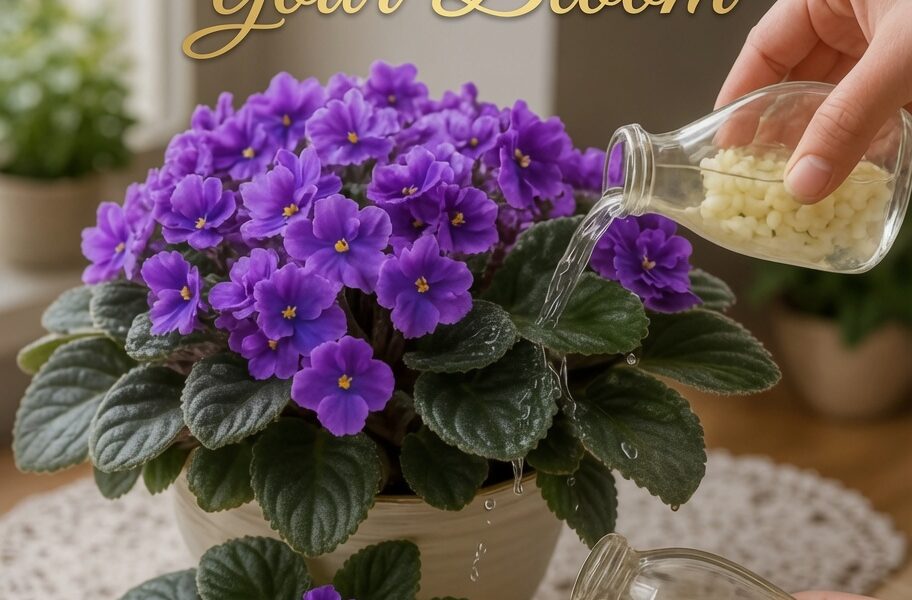
How to Make African Violets Bloom with a Homemade Ingredient
African violets are one of the most beloved houseplants for their beauty and delicate flowers, but they are also known for being somewhat capricious when it comes to flowering. Many people wonder why their plant produces abundant and healthy leaves, but fails to give flowers. The good news is that there is a homemade, inexpensive, and natural solution that can stimulate abundant flowering in a short time.
Why African Violets Stop Blooming
Before applying any fertilizer, it is important to understand the most common reasons why an African violet stops producing flowers. Among the main factors are the lack of adequate light, excess or underwatering, a substrate depleted of nutrients, lack of ambient humidity or the use of pots that are too large. These plants prefer to be slightly cramped in their pot and need indirect bright light for several hours a day.
When these basics are covered and the plant is still not flowering, it will most likely be lacking specific nutrients, particularly phosphorus and potassium, which are the elements that drive flower bud formation.
The one-tablespoon homemade fertilizer
The most effective and simple method is to prepare a natural fertilizer based on ingredients that are usually available in any kitchen. Only one tablespoon of this preparation is needed to achieve visible results in a few weeks.
Ingredients needed
- Dried and ground banana peels: they are a natural source of potassium, essential for flowering.
- Crushed eggshells: provide calcium, which strengthens the stems and leaves.
- A little dry yeast: stimulates the microbial activity of the substrate and promotes the absorption of nutrients.
- Water at room temperature: preferably steep for 24 hours to remove chlorine.
Step-by-step preparation
Dried banana peels and eggshells are finely ground into a powder. Mix a teaspoon of each with a small pinch of dry yeast. The mixture is then dissolved in a liter of warm water and left to sit for at least two hours so that the nutrients are released.
After this time, the liquid is strained and stored in a clean container. This preparation can be kept in a cool place for several days.
How to Apply Fertilizer
The application must be done carefully so as not to damage the roots or leaves of the violet. Ideally, you should water the plant with a tablespoon of the preparation diluted in a glass of water, placing it directly on the substrate and avoiding wetting the leaves, as African violets are sensitive to moisture in their foliage.
It is recommended to apply this fertilizer once every fortnight. In a few weeks, new flower buds will begin to appear between the leaves, and the plant will regain its vitality.
Complementary care for long-lasting flowering
In addition to homemade fertilizer, there are other treatments that enhance the results and keep the African violet in optimal conditions to bloom continuously.
Adequate light
These plants need bright but indirect light. An east-facing window is usually ideal. If natural light is insufficient, grow lamps can be used for a few hours a day.
Correct watering
Watering should be done from below, placing the pot in a dish with water for 15 or 20 minutes so that the substrate absorbs the necessary moisture. The roots should never be allowed to become waterlogged.
Ambient humidity
African violets thrive in environments with moderate humidity. Placing the pot on a plate with stones and water, without the base touching the liquid, helps to maintain moisture around the plant.
Stable temperature
The ideal temperature is between 18 and 24 degrees. Sudden changes and cold drafts can stop flowering.
Removing wilted leaves and flowers
Carefully removing yellow leaves and dried flowers allows the plant to devote its energy to producing new flower buds.
Short-term results
With this combination of natural nutrients and basic care, even African violets that haven’t bloomed for months can surprise with an explosion of blooms in just three to four weeks. This method is especially valuable because it avoids the use of chemicals, is inexpensive, and uses organic waste that is normally discarded.
The key is consistency: applying fertilizer regularly, maintaining the right light and watering conditions, and observing the plant to respond to its needs. With patience and these small gestures, any African violet can grow into a flowering plant for much of the year.