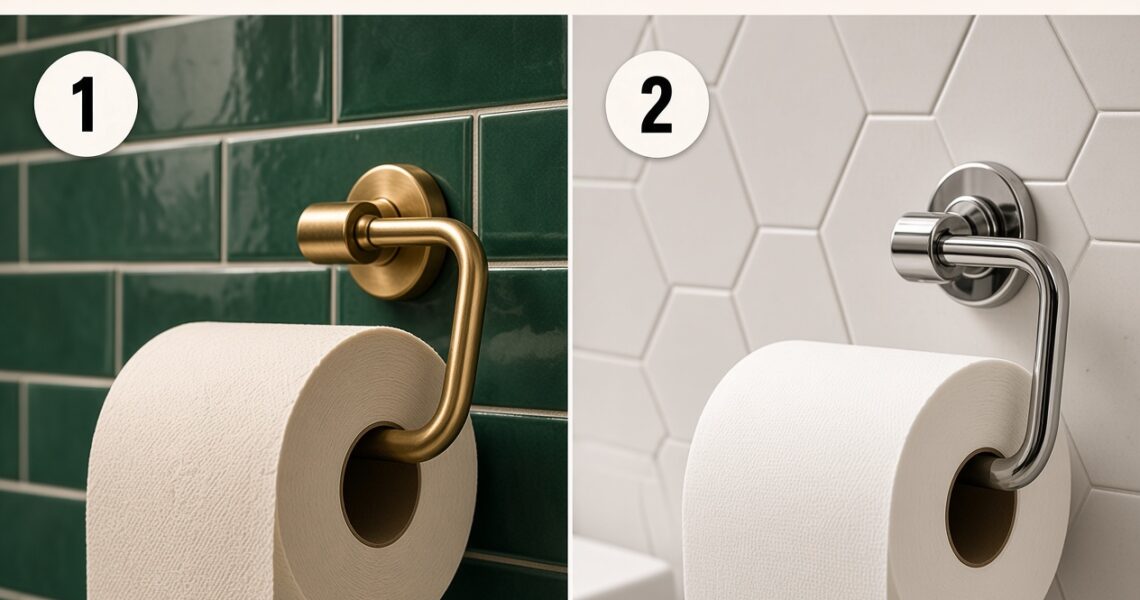
What is the correct way to place toilet paper? The family debate that resolved an 1891 patent
It may seem like a trivial question, but few domestic discussions have divided families as much as this one: should toilet paper fall over the roll or from behind? In every home there are staunch defenders of one position or another, and many are convinced that their form is the only correct one. The curious thing is that there is a document from the late nineteenth century that, according to many experts, settles the discussion once and for all.
A debate older than you imagine
Ever since toilet paper rolls became popular in homes, people have developed very strong preferences for how to place it in the roll holder. Surveys carried out in different countries show that the majority of the population is inclined to drop the paper in front (outwards), while a significant group prefers it to fall in the back (towards the wall).
The interesting thing is that each side has arguments that it considers irrefutable. It is not just an aesthetic issue: there are reasons of hygiene, comfort and even decoration behind each choice.
The arguments of those who prefer “ahead”
Those who defend placing the roll with the paper falling outwards highlight several advantages:
- Greater hygiene: the fingers only touch the paper to be used, without rubbing the wall or the back of the roll, where germs could accumulate.
- Easy to find the end: the edge is visible and accessible, without the need to fumble for it.
- Presentation in hotels: establishments usually bend the triangle tip to indicate that the room was cleaned, and this only works if the paper falls in front.
- Comfort when cutting: it is easier to tear the paper with one hand.
The arguments of those who prefer “from behind”
On the other hand, those who choose to have the paper fall towards the wall also have their reasons:
- Neater appearance: the roll looks more discreet because the edge is hidden.
- Protection against pets and children: if there are cats, dogs or small ones at home, it is more difficult for them to unroll all the paper by playing with it.
- Less waste: some say that with this position you tend to take less paper than necessary.
- Minimalist style: Many people simply find it more elegant.
The patent that reveals the original answer
Here comes the fact that has surprised millions of people around the world. In 1891, an American inventor named Seth Wheeler filed a patent for perforated roll toilet paper as we know it today. This document, catalogued under the number US465588, includes detailed illustrations of how the product should be used.
And the images are quite clear: in the original patent drawings, the toilet paper appears falling in front of the roll, i.e. outwards and not towards the wall. Wheeler designed the system with perforated sheets in mind that they would be easy to pick up and separate, and to achieve this, the paper had to hang from the front.
When this document came to light and went viral on social networks, many people were shocked to discover that, technically, there was an “official form” proposed more than 140 years ago by the creator of the invention himself.
Does this mean that there is only one correct answer?
Although Wheeler’s patent suggests that the original intention was to put paper in front, the truth is that there is no mandatory law or rule that indicates how we should do it in our homes. Each person can choose the option that is most practical for them according to their circumstances.
For example, a family with curious cats may have good reasons to place it facing the wall, while those who prioritize hygiene or hotel-like style will prefer the outward position.
The conclusion of the great debate
In the end, the “great mystery” of toilet paper has a clear historical answer: according to the original patent from 1891, the paper must hang in front of the roll. That was the design that Seth Wheeler devised and legally protected more than a century ago.
However, beyond the curious fact, the truth is that the best way to place toilet paper is the one that adapts to the needs of each home. The next time the discussion arises at the family table, you know with what historical argument to defend your position… or to understand that of others. After all, it is a small domestic detail that, although it may seem insignificant, has managed to divide opinions for entire generations.