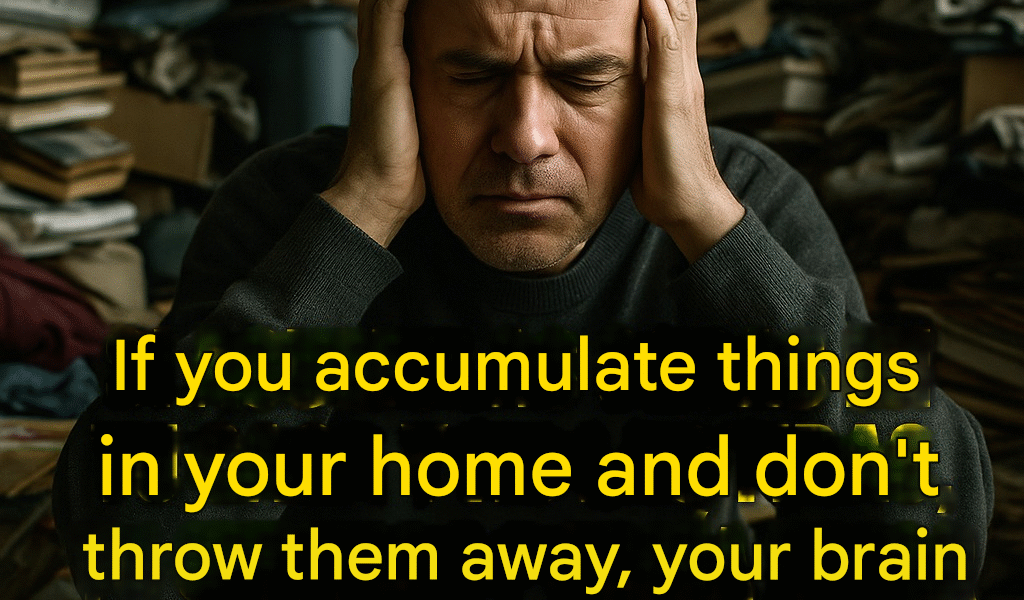
If you hoard things in your house and don’t throw them away, your brain could be trapped in this hidden pattern
Have you ever felt like your house is full of objects that you don’t use but can’t throw away either? From clothes you no longer wear, to papers that pile up in a drawer, the act of hoarding can seem harmless.
However, behind this daily habit can hide a deep psychological pattern that directly affects your emotional and mental well-being. According to psychology, what we accumulate reflects more than we imagine: fear, insecurity, unresolved memories, and even a way to protect ourselves from change.
What does it mean to hoard things and not throw them away according to psychology?
Psychologists point out that hoarding objects isn’t always about “clutter” or “laziness.” It is often linked to internal processes and deep emotions. Here are some of the most common reasons:
- Fear of scarcity
Those who have experienced economic shortages or situations of uncertainty may develop the need to keep everything “just in case”. - Emotional
attachment Objects are loaded with memories and personal meanings, and letting go of them is perceived as losing a part of one’s history. - Perfectionism and procrastination
The difficulty in deciding what to keep and what to throw away can be linked to the fear of making a mistake. Then the decision is postponed and the objects accumulate. - Feeling of control
For some people, surrounding themselves with things generates an illusion of security and stability, although in reality it causes the opposite effect: anxiety and stress. - Emotional voids
Accumulation can be a way to fill an internal void, replacing with things what is missing on an affective or spiritual level.
How hoarding affects your daily life
Invisible stress in your environment
A space full of pending things transmits a constant message of “unresolved task” to the brain. This generates anxiety and a feeling of mental exhaustion.
Difficulty moving forward
Holding on to the old can prevent us from making room for new experiences, relationships, and opportunities. Physical accumulation reflects internal stagnation.
Impact on self-esteem
A cluttered home can lead to feelings of guilt, shame, or even social isolation. Many people avoid having visitors because they feel like their space is “not up to par.”
Tips for overcoming accumulation
- Start small: don’t try to declutter the entire house in one day. Choose a drawer, a table or a corner and work on it.
- Ask yourself key questions: Before you put something away, ask yourself, “Do I use it? Do I need it? Does it make me happy?”
- Apply the rule of the year: if you haven’t used an item in the last 12 months, you probably don’t need it.
- Separate into categories: donate, recycle, preserve. Having a clear system helps to decide faster.
- Work on emotional detachment: remember that memories are not in things, but in you. A photo can be digitally preserved; A memory lives in your memory.
- Seek professional help: If hoarding causes suffering or interferes with your daily life, talking to a psychologist can be an important step.
Accumulating things is not always a simple mess. Many times it is the reflection of wounds, fears and hidden patterns in our mind. Taking the step of letting go not only frees up physical space, but also emotional space. Every object you decide to let go of is a way of telling your brain, “I’m ready to move forward.”