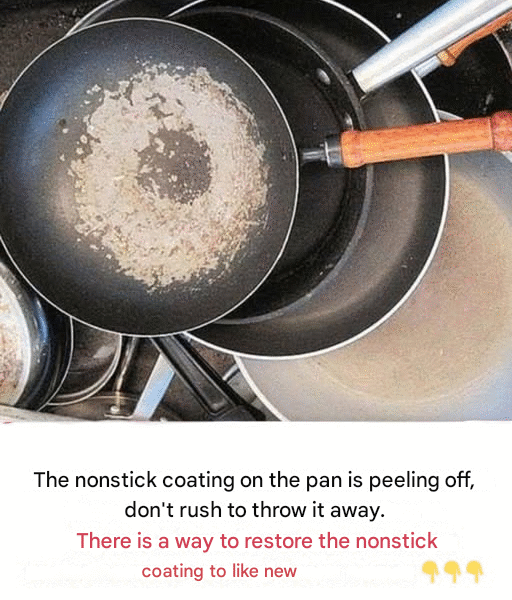
There’s a way to restore the nonstick coating to like-new condition.
With daily use, nonstick pans begin to lose their magic. At first, the egg slides right off without oil, but over time, everything sticks, burns, or becomes difficult to clean. The good news is you don’t have to throw it away right away or spend a fortune on a new one . There’s a little-known homemade trick that can help you restore nonstick properties naturally and inexpensively : using milk.
Yes, the milk you have in the fridge could be the solution to recovering that pan you thought was lost.
Why can milk restore non-stick coating?
The key lies in a protein called casein , present in milk. When heated, this protein solidifies slightly and adheres to the metal surface , forming an invisible film that improves food glide and acts as a temporary protective layer.
This method doesn’t repair damaged Teflon , but it does create a natural barrier that improves cooking. It’s ideal for pans that are worn but not yet scratched .
Step by step: how to restore non-stick coating with milk
1. Choose the right milk
You can use regular milk, whole milk, or skim milk, even expired milk if it doesn’t have a bad odor. It can be sweetened or unsweetened, although it’s best to use unflavored milk with no additives to avoid sticky residue.
Tip: Use leftover milk from a recipe or milk that’s about to expire to avoid waste.
2. Pour the milk into the pan
Add just enough to cover the entire bottom of the pan . There’s no need to fill it up. Just make sure the entire base is in contact with the milk.
3. Boil over low heat
Place the pan on the stove over low to medium heat and let the milk simmer for about 5 minutes. Avoid high heat to prevent it from boiling over or burning.
During this time, the milk will form a thin film on the surface. This is what creates the non-stick effect.
4. Discard the milk and wash the pan
Once the 5 minutes are up, let it cool slightly, discard the milk, and wash the pan with warm water and a soft sponge , without abrasive detergents. There’s no need to scrub vigorously. Make sure there’s no milk smell left.
Bonus tip: If you don’t want to throw away the milk, you can use it to clean and neutralize odors in the refrigerator.
5. Take the final test
Dry the pan thoroughly and try cooking an egg without oil or with just a few drops . If it doesn’t stick and can be easily turned, the casein film worked, and you’ve restored the nonstick function.
How often can it be repeated?
You can use this method once a week or every 10 days , depending on how much you use the pan. It’s also ideal for pans you use sporadically and want to keep in good condition.
Homemade alternatives if you don’t have milk
If you don’t want to use milk, there are other natural solutions that can help:
- Oil and coarse salt : Heat the pan with a little oil and coarse salt, and rub gently. This helps remove residue and improve glide.
- Vinegar and baking soda : a useful mixture for cleaning stuck-on residue and disinfecting, although it does not restore non-stick properties.
- Food-grade beeswax (less common): Used to create a natural coating on iron or steel, but is not suitable for Teflon.
Care to make your pan last longer
- Never use metal utensils : always use spatulas made of wood, silicone, or heat-resistant plastic.
- Don’t wash it in hot water : wait for it to cool before washing it, this way you avoid it becoming deformed.
- Do not scrub it with abrasive sponges or steel wool .
- Cook over low to medium heat . Excessive heat will damage the nonstick coating.
- Do not use it to store cooked food or leave it wet.
When should it be changed?
This method works as long as the nonstick coating is worn but not broken . If you already see deep scratches, loose Teflon, or peeling areas, it’s best to replace the pan .
Cooking on a damaged surface can release toxic substances , especially if the pan was made with older Teflon. In these cases, it’s best not to continue using it or attempt to repair it.
Conclusion
Refinishing your pan with milk is a natural, economical, and effective solution for cookware that’s starting to lose its nonstick coating but isn’t broken yet. It’s ideal for giving your pans a second life and avoiding frustrating cooking.
With just a little milk and a few minutes of your time, you can once again enjoy an egg that doesn’t stick, pancakes that slide right off the pan, and a pan that’s easier to clean .