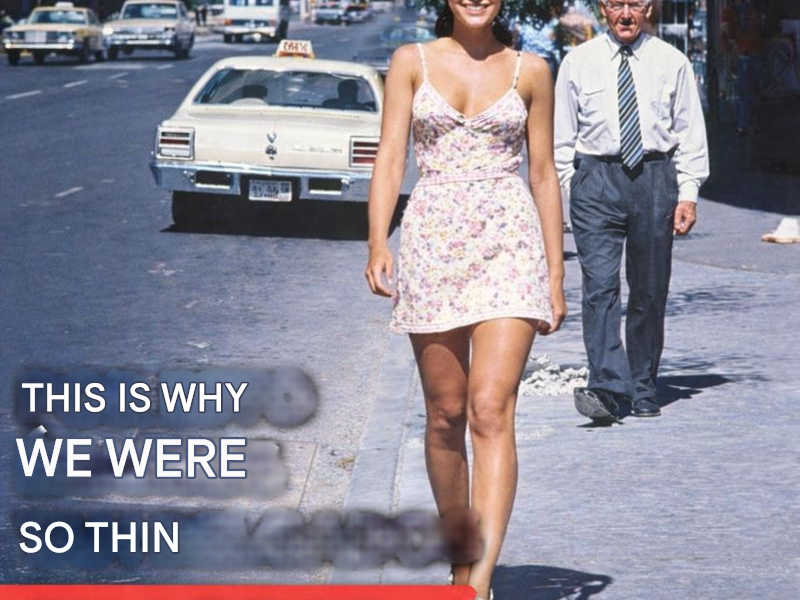
Why We Were So Thin In The 70s (The Truth Will Surprise You)
There was a time – not so long ago – when seeing someone with obesity was rare. Just look at family photos, school pictures or beaches from the seventies: almost all of them looked slimmer, more active and more energetic.
It wasn’t miracle diets or extraordinary willpower. The real reason is that the world worked differently. The environment, habits, and daily life forced the body to stay in balance.
Here are the real reasons why bodies in the 70s were so different.
1. Walking was the natural way to move
In the ’70s, most families had only one car or none at all.
To go to school, work, the store or to visit a friend, you walked. Not as an exercise, but as a necessity.
An average adult walked between 8 and 12 kilometers a day without even noticing it:
- From home to bus stop
- From the bus to work
- From work to trade
- From commerce to home
The children walked to school alone from a very young age, played in the street, went to the park, returned home… all on foot.
The body was in constant motion.
2. Food was real food
The refrigerators were not full of ultra-processed products.
There were:
- Eggs
- Vegetables
- Fresh meat
- Milk
- Fruits
There were no endless lists of ingredients, no corn syrup, no invisible additives.
Meals were prepared from scratch.
Cooking took time: peeling, cutting, boiling, frying, mixing.
That was already physical activity.
In addition:
- Sugar was used sparingly
- Fats were natural
- Portions were reasonable
They did not eat out of anxiety, but out of real hunger.
3. There was no constant snacking
In the 70s you ate three times a day:
- Breakfast
- Lunch
- Dinner
And nothing else.
There were no snacks everywhere.
There were no vending machines.
There was no candy in the supermarket checkout.
The body learned to respect the schedule.
Between meals, it was simply expected.
This allowed the metabolism to regulate itself and the body to burn what it had consumed.
4. Portions were much smaller
A soft drink was 200 ml.
A hamburger fit in the hand.
The potatoes came in small bags.
There were no giant sizes or “enlarge for a few cents more”.
Food was served to feed, not to saturate.
The stomach was not stretched by years of excess.
5. Television did not dominate life
The television had schedules.
It was turned on to watch a program and turned off.
There were no endless marathons or screens on all day.
The children had an hour or two of television, and then they went outside to play.
In addition:
- No one ate in front of the screen
- The table was for eating, not for distraction
Today we spend more than 11 hours a day in front of screens.
In the 70s, only 2.
6. Stress was not eaten
There was no constant bombardment of bad news, messages, emails and notifications.
The stress was punctual, not permanent.
And food was not an emotional anesthetic.
If someone was sad, they would go for a walk, talk to a neighbor, or do something with their hands.
That also burned energy.
In addition, he slept better.
And sleep regulates hunger hormones.
7. Work was movement
Even office jobs required moving:
- Walk to other floors
- Search for files
- Go to the bank
- Carrying papers
- Climbing stairs
Manual jobs were even more common: farming, factories, construction, maintenance.
The work itself was exercise.
8. There were no personal screens
There were no cell phones, no computers, no advanced video games.
If you were bored, you went out.
If you wanted to see friends, you visited them.
If you wanted to entertain yourself, you did something.
Boredom pushed movement.
Today, boredom leaves us still.
The truth that no one wants to accept
People in the 70s were not more disciplined.
She lived in an environment that forced her to move and eat with balance.
Today we live in a world designed to keep you going, to eat all day and to sit in front of a screen.
And the body pays the price.
Tips and recommendations to apply today
You don’t need to live like you did in the 70s, but you can recover key parts:
- Walk more, even if you have a car
- Cook more at home with real ingredients
- Reduce snacking between meals
- Use smaller plates
- Turn off screens during meals
- Sleep better
- Get up and move every hour
- Get more outdoors
The body does not need extreme diets.
You need an environment that lets you work as designed.
The thinness of the 70s was not magic or genetics.
It was the result of a more active, less artificial and more human life.
Recovering a part of that lifestyle can change everything.
👉 Follow our page, like 👍, and share this post. Every click can make a difference—perhaps saving your own life or that of a loved one.