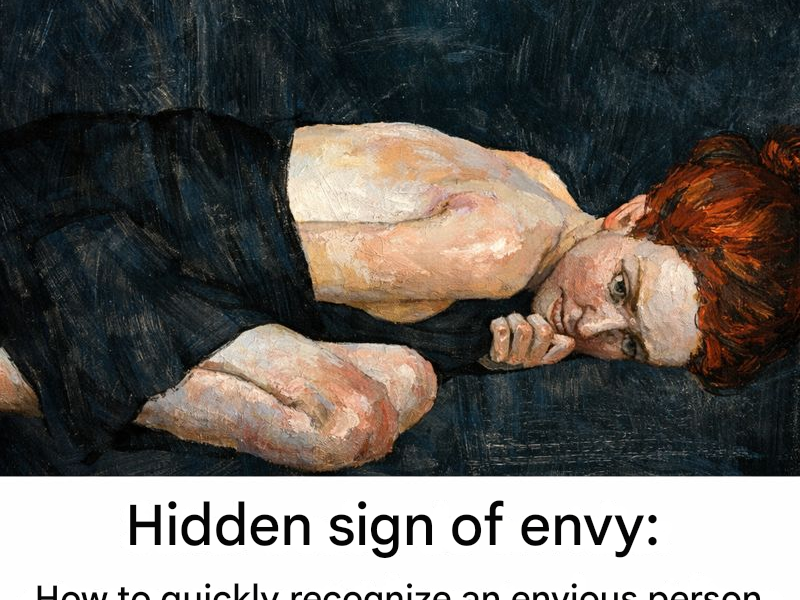
A subtle sign of envy and how to identify it in everyday relationships

Envy is a common human emotion that appears when we desire something that someone else has or when we feel comparatively inferior. It is often confused with jealousy, but envy refers specifically to the desire to possess what another person owns, while jealousy is more related to the fear of losing something valuable in a relationship.
Although it can manifest itself explicitly, in many relationships – family, work or friendship – envy is hidden behind subtle behaviors that are difficult to interpret if we are not alert.
Why can envy go unnoticed?
Envy is not always expressed with aggressive comments or open confrontations. In social contexts, people tend to hide their true feelings to maintain an image of cordiality or normality. This causes many envious behaviors to be presented as “normal” or “casual,” when in reality they reflect an internal conflict in the other person.
Subtle Signs of Envy in Everyday Relationships
1. Congratulations with a strange tone
They may seem to celebrate your accomplishments, but their words lack genuine enthusiasm. Sometimes comments seem forced or with negative overtones disguised as a joke (e.g., “Good for you… I guess!” with a smile).
2. Minimizing Your Successes
A common response of envy is to make your accomplishments seem less important. They can say things like “It’s not that bad” or “Anyone can do that,” detracting from what was a meaningful goal for you.
3. Constant criticism without offering support
When someone criticizes your decisions, results, or even your ideas frequently and without providing constructive intent, they could be expressing internal dissatisfaction disguised as advice.
4. Emotional withdrawal or distance at important moments
An envious person may avoid participating or be absent when you share something positive, such as personal accomplishments or good news. This distancing may seem “normal”, but its origin is usually a discomfort when facing your well-being.
5. Excessive competitiveness
Beyond healthy competition, some people feel the need to constantly compare themselves to you or to “outdo yourself” in every conversation or situation. This may indicate that your success awakens in them an unresolved desire to excel.
6. Empty praise or sarcasm
Comments that seem positive but contain a slight covert criticism or a sarcastic tone are a typical way to express envy without direct confrontation.
Why it’s important to identify them
Spotting these signs isn’t about “labeling” someone as a bad person, but about understanding dynamics that can affect the quality of your relationships. Unresolved envy can lead to silent tensions, resentment, or even emotional sabotage—such as passive-aggressive comments or constant comparisons—if not addressed clearly and empathetically.
How to handle these situations in a healthy way

Before assuming that someone is envious, reflect on whether their behavior is recurrent and consistent in different circumstances. A single isolated gesture is usually not enough to conclude it.
If the relationship allows, expressing how certain comments or attitudes make you feel with respect can open up an honest dialogue that clarifies underlying misunderstandings or tensions.
When you detect repetitive patterns that affect you emotionally, it’s healthy to set clear boundaries to protect your well-being without falling into harmful confrontations.
Seek to surround yourself with people who not only celebrate your triumphs, but also genuinely support you when you share your goals and challenges.
Conclusion
Envy is a complex human emotion that can manifest itself in subtle and often unnoticed ways within everyday relationships. Learning to identify these cues allows you to better navigate your bonds, maintain your emotional balance, and promote more authentic and respectful interactions.
Recognizing how envy is expressed—from ambiguous comments to passive attitudes—gives you a valuable tool to protect your peace and strengthen healthy relationships in your daily life.
👉 Follow our page, like 👍, and share this post. Every click can make a difference—perhaps saving your own life or that of a loved one.