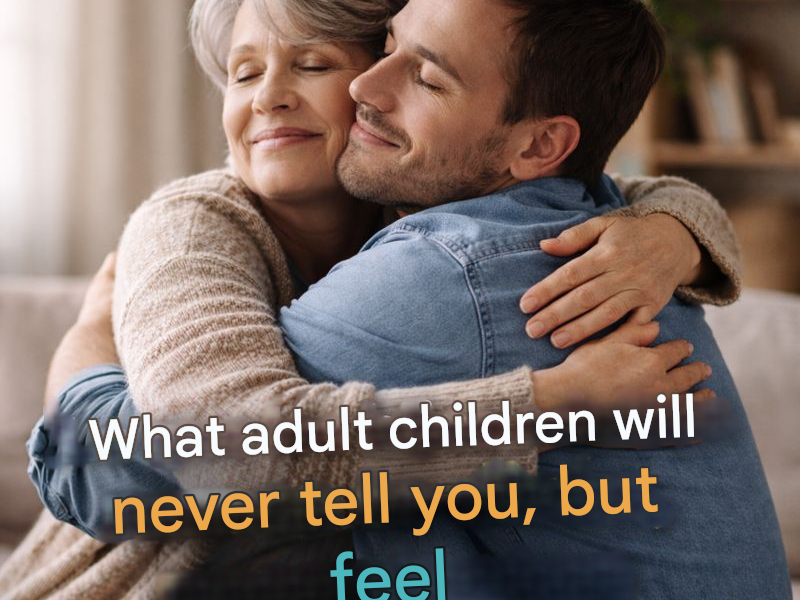
What Adult Children Will Never Tell You, But Feel

When children grow up, something changes quietly. They no longer ask permission, they no longer ask so many questions, they no longer call every day… But that doesn’t mean they don’t need their parents anymore. What happens is more complex: love is still there, but now it lives with guilt, fears, comparisons and wounds that are rarely expressed out loud.
Many parents believe that if their adult child doesn’t say anything, then everything is fine. The truth is that most adult children harbor emotions that they never dare to confess, not because of lack of love, but because of fear of causing pain, conflict, or disappointment.
Here’s what they feel… even if they never say it.
1. They still need your approval
Even if they already have their own life, job, partner or children, deep down many adult children are still looking for something very specific: to feel that their parents are proud of them.
No matter how many achievements they accumulate, if they feel like it’s never enough for you, something inside of them contracts. A single phrase like “I thought you could do better” can outweigh a hundred external praise.
What they don’t say is,
“I want you to look at me like you did when I was a kid and you felt like I was enough.”
2. They feel guilty for not being more present
Adult life absorbs. Work, responsibilities, tiredness, own problems. Still, every time an adult child walks away, they often carry silent guilt.
It is not always heartbreak.
Many times it is exhaustion.
But they don’t know how to explain it without seeming selfish or cold, so they just distance themselves… and the guilt grows.
3. Sometimes they feel like they’ll never be able to meet your expectations
Many adult children live with the feeling that they are always failing their parents in some way: they don’t earn enough, they didn’t choose the right partner, they didn’t have children, or they had them too late.
On the outside they seem safe.
Inside they feel that they are always on trial.
What they don’t say is,
“I feel like I can never be exactly who you expected.”
4. It hurts when their emotions are minimized
When an adult child expresses tiredness, sadness, or frustration, and receives responses such as: “That’s nothing” “It used to be worse”
“Stop exaggerating”
What he learns is that his emotional world has no space.
Then he falls silent.
Not because he doesn’t feel, but because he feels too much… and does not feel heard.
5. They want to be treated like adults, not children
One of the most silent conflicts is this: the child has grown up, but at home he is still treated as if he does not know how to make decisions.
Unsolicited advice.
Constant criticism.
Corrections about their way of life.
That creates an invisible distance that they don’t always know how to explain without hurting you.
6. They’re afraid of disappointing you
Many adult children avoid telling the truth about their lives, their problems, or their mistakes because they are afraid of breaking the image you think you have of them.
They don’t want to see you suffer.
They don’t want to feel like they failed you.
So they are silent.
They smile.
And they charge alone.
7. Sometimes they feel like they have to choose between you and their life
When a parent does not accept natural changes—a partner, a job far away, new priorities—the adult child feels that he or she must choose.
And neither of the two options ceases to hurt.
They don’t want to lose you.
But they can’t lose themselves either.
Final Thoughts
Adult children do not move away because they stop loving.
They walk away when they can’t find a safe place to be who they are.
Behind the silence, the less frequent calls and the distance, there is almost always a mixture of love, fear, guilt and desire to be accepted as they are.
Sometimes, all they need is no more advice…
but to feel seen, heard and respected.
Because even when they grow up,
they remain, deep down,
your children.
👉 Follow our page, like 👍, and share this post. Every click can make a difference—perhaps saving your own life or that of a loved one.