What changes usually appear after the age of 70 and why it is advisable to know them in time.
The body doesn’t ask permission when you reach 70. It just starts to change. It does not do so all at once or with clear warnings, but silently and progressively. Many people believe that if they feel good, nothing bad is happening. But the reality is different: certain changes come to everyone, without exception. The difference is not in avoiding them, but in preparing in time.
Over decades of clinical observation, it has been proven that there are physical and neurological transformations that explain why many older people lose balance, strength, or confidence when moving. Understanding them is the first step to not letting them define the rest of your life.
1. The balance system begins to fail
After the age of 70, the inner ear, which is responsible for balance, slowly degrades. The sensors become less accurate and the brain receives confusing signals. That is why the feeling of instability, dizziness when getting up or the impression that the environment “moves” appears.
The most dangerous thing is that this deterioration is not always noticeable when walking normally. Many people discover the problem only after a fall.
The key: train your balance daily so that your brain adapts and compensates for the loss.
2. Reaction time slows down
Over the years, the nervous system slows down. The brain takes longer to process what it sees, and the muscles respond with delay. That difference of fractions of a second is enough to not brake in time, not to hold on to a railing or not to avoid a fall.
It’s not distraction or inattention. It’s biology.
The good news is that the nervous system can be trained even at an advanced age.
3. Muscles weaken without you noticing it
This process is called sarcopenia. From the age of 50, muscle mass decreases every year, but after the age of 70 the loss accelerates. Suddenly, simple actions like getting up from a chair, carrying bags, or opening a jar become difficult.
Loss of strength is one of the main reasons why many seniors stop living independently.
4. Bones become brittle
Osteoporosis progresses silently. It doesn’t hurt, it doesn’t warn and you don’t feel it… until a fracture occurs. In many cases, the bone breaks before the fall, not as a result of it.
A hip fracture can be life-changing in seconds and set off a chain of serious complications.
5. You lose the perception of your own body
Proprioception is the ability to know where your feet, hands, and body are without looking. With age, that “internal map” becomes imprecise. That is why many people stumble even though they clearly see the obstacle.
The brain thinks the foot lifted high enough, but it actually didn’t.
6. Reacting to a fall takes twice as long
When a young person stumbles, the body reacts almost immediately. At 75, that response can take twice as long. That minimal delay is the difference between regaining one’s balance or ending up on the ground.
Although the aging of the nerves cannot be completely reversed, it can be compensated with specific training.
7. Fear increases the risk of falling
Paradoxically, the fear of falling causes many people to move stiffly, take short, tense steps, and lose stability. The rigid body is an unstable body.
Trust is also physical. When a person trusts their body again, they move better and more safely.
Practical tips and recommendations
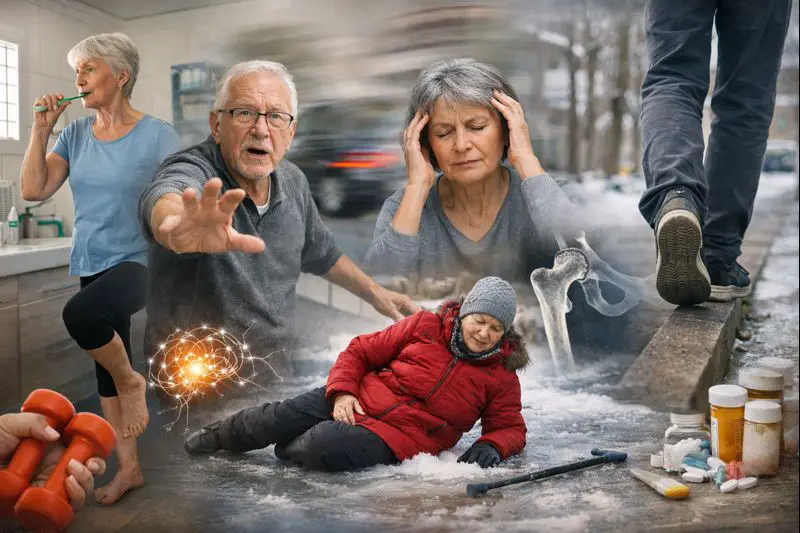
- Balance train every day: Stand on one foot while brushing your teeth, start with 10 seconds and work your way up.
- Strengthen your muscles: Use elastic bands or simple resistance exercises, even if it’s just 15 minutes a day.
- Work on coordination: throwing and catching a ball, reaction games or hand-eye exercises help the nervous system.
- Take care of your bones: combine moderate-impact exercise, a diet rich in calcium, and adequate vitamin D levels.
- Exercise proprioception: walk in a straight line supporting heel to toe, or try to reach for objects with your eyes closed.
- Check your medications: some increase dizziness and risk of falls; Always consult a professional.
- Regain confidence: moving calmly but without fear is a fundamental part of stability.
Turning 70 doesn’t mean losing your independence. It means your body needs different training, not less movement. These changes happen, but they don’t have to dominate your life. Starting today can make the difference between limiting yourself… or continue to advance safely for many more years.
👉 Follow our page, like 👍, and share this post. Every click can make a difference—perhaps saving your own life or that of a loved one.