Is it advisable to keep photos of deceased people at home? What many people wonder.
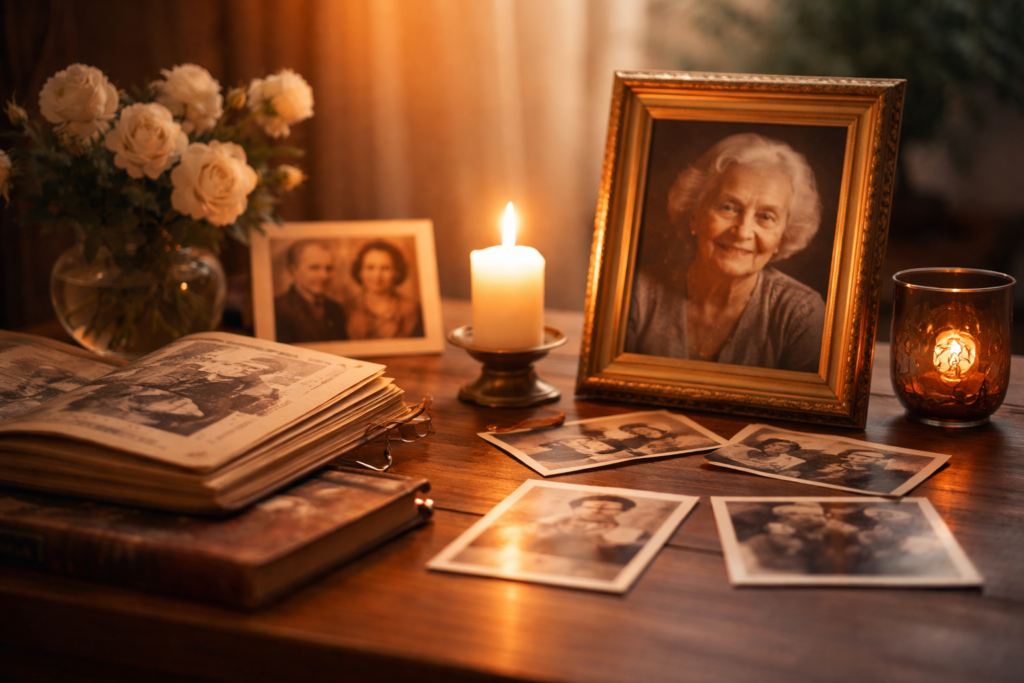
Many people live with a silent doubt that, over time, turns into fear:
is it right to keep photographs of loved ones who are no longer there?
Some look at them with nostalgia and end up trapped in a deep sadness.
Others, on the contrary, hide them or even eliminate them for fear that they bring “negative energies”.
But what is really behind all this?
The origin of fear: beliefs that harm
Surely you have heard phrases like:
- “Photos of the dead attract bad energy”
- “The soul is trapped in the image”
- “It can affect children or the home”
These ideas, although widespread, have no real basis. They are beliefs that are born of fear, ignorance or superstitions that are repeated without question.
A photograph is nothing more than a memory captured in an instant.
It contains no souls, dark energies, or hidden forces.
So why does it hurt so much to look at a photo?
Here’s the real key.
The problem is not in the photograph…
it is in what awakens within us.
When you see the image of someone you love and they’re gone, it doesn’t hurt the photo itself.
The emptiness, the absence, what was not said, what was not done, hurts.
And when that pain isn’t processed in a healthy way, it can morph into something deeper:
- Constant sadness
- Feeling of emptiness
- Attachment to the past
- Difficulty moving forward
The real mistake: turning memory into suffering
There are people who, without realizing it, turn their home into a space of permanent sadness.
Photos everywhere, untouchable memories, objects that don’t move…
and a life that seems frozen in time.
You talk to the images, you cry in front of them, you relive the pain over and over again.
And in this process, something important happens:
the person stops living in the present.
He distances himself from those who are still by his side.
He disconnects from real life.
The true meaning of photographs
Photos are not to make you suffer.
They are there to remind you:
- The Love That Existed
- The shared moments
- The lessons they left
They are like a “door” to memory… not a place to get trapped.
A photograph should elicit a soft smile, a warm emotion…
not constant pain.
How to Properly Handle Photos of Deceased Loved Ones
There is something very important here: it is not a question of eliminating them or ignoring them, but of giving them their rightful place.
1. Don’t turn memory into an altar of pain
Avoid constantly staring at those images with sadness. Remembrance should be love, not suffering.
2. Respect your emotional times
If it still hurts too much, it’s okay to save the photos for a while. It is not forgetting, it is emotional care.
3. Transform memory into something positive
Instead of crying, be thankful. Remember the good, the lived, the learned.
4. Be present with the living
The people who are with you today also need your love, your attention, and your energy.
Love doesn’t go away
One of the most profound truths is this:
love does not end with death.
The people who left don’t live in a photo…
They live in what they left in you.
In your values.
In your memories.
In your way of seeing life.
Tips and recommendations
- Avoid obsessing over the past. Remembering is not the same as living anchored.
- He talks about that person from love, not from constant pain.
- Surround yourself with people who help you move forward emotionally.
- If the grief is very intense, seek professional support.
- Do activities that connect you with life: walking, sharing, creating.
- Be grateful for what you have experienced instead of focusing on what you missed.
Having photos of deceased loved ones is not a bad thing.
What really matters is how you relate to those memories.
When love turns into gratitude, it heals.
But when it transforms into constant attachment and pain, it can slowly destroy you.
Always remember:
honoring those who have left also means continuing to live fully.