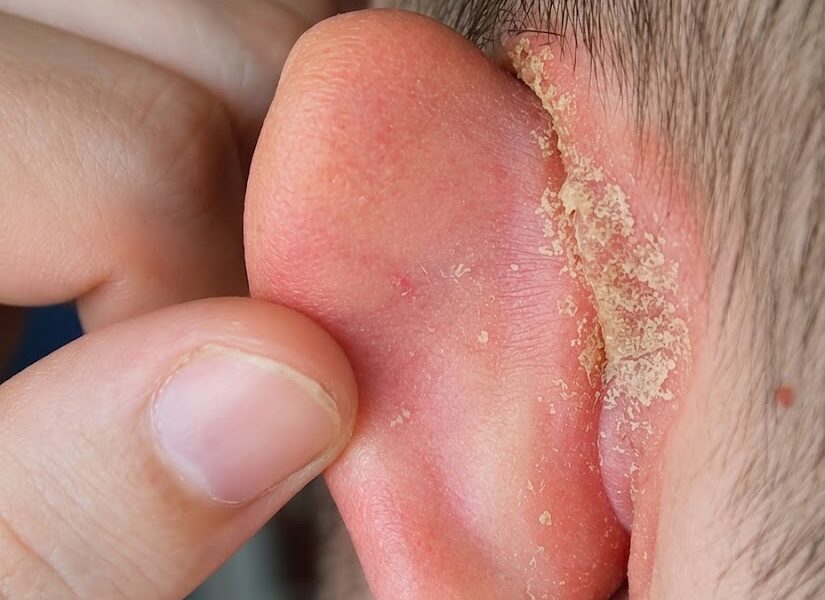
Spot on the child’s ear: possible causes and care at home until the doctor’s office
Waking up and noticing a strange spot on the child’s skin, especially behind or over the ear, usually causes concern in any parent. The situation becomes more stressful when the consultation with the pediatrician or dermatologist is only available several days later, leaving the family with doubts about how to act.
Although it may seem alarming, this type of skin manifestation is quite common in childhood. In many cases, what appears to be a serious problem may be childhood eczema, a common inflammation of the sensitive skin of the little ones.
Why is the ear a common area of childhood eczema?
One of the most common causes of these lesions is atopic dermatitis, which tends to appear in particularly delicate areas such as behind the ears, the folds of the arms and the back of the knees. When it occurs, the skin may be red, rough, very itchy, and even peel off small scabs.
The skin of the ear is very thin and is exposed to multiple irritants on a daily basis: tight caps, headphones, traces of shampoo that drip off during bathing or constant contact with synthetic fabrics. In addition, atopic dermatitis can be aggravated by factors such as:
- Sudden changes in temperature.
- Presence of dust in the environment.
- Bathrooms with water that is too hot.
- Family history of allergies, rhinitis, or asthma.
Signs to look out for
It is important to observe the child’s skin calmly and look for the following signs:
- Redness and rough texture.
- Persistent itching that doesn’t seem to soothe.
- Small pimples or flaking.
- Scabs or marks of constant scratching.
These symptoms do not always indicate severity, but they are an alert to start the first basic care at home.
Home care to relieve symptoms
The first thing is to stay calm. Many childhood eczema cases improve with simple measures, and the way in which the situation is managed directly influences the evolution of the skin.
Some actions that usually work well while waiting for the medical appointment are:
- Wash the area with a neutral soap, preferably for children, and rinse with warm water.
- Dry the skin with a clean towel, giving small soft touches, without rubbing.
- Apply a hypoallergenic moisturizer for sensitive skin.
- Use a cold compress if the itching is very bad.
- Avoid accessories or clothing that continuously rub against the affected area.
In some cases, creams with 1% hydrocortisone can help, but it is advisable to use them in moderation and, if possible, with some prior medical guidance, even if it is informal.
When is it necessary to seek care before the consultation?
Most cases of atopic dermatitis progress slowly and can be managed at home for a few days. However, there are signs that you should not wait:
- The area becomes very hot, swollen, or begins to ooze pus.
- The child has a fever or is more irritable than usual.
- The skin appears painful, not just itchy.
- There is a visible worsening within a few hours.
These may be indications of a secondary infection, a situation in which it is necessary to seek medical attention urgently.
How to prepare for your appointment day
While waiting for your turn, writing down as much as possible makes the professional’s job much easier. The doctor will likely ask detailed questions, and having the information on hand allows for a clearer answer.
It is advisable to record:
- When and how the stain appeared.
- What products or treatments were applied.
- If the child had contact with any new food or products.
- History of allergies or similar episodes.
A useful recommendation is to take daily photos of the affected area. In this way, the professional will be able to see the evolution of the condition even if the skin is already better on the day of the consultation.
Can new attacks of atopic dermatitis be avoided?
After a childhood eczema flare-up, many families understand that the child’s skin needs more constant care. Prevention, in this case, is just as important as treatment.
Some measures that help in the long term are:
- Moisturize the skin every day, even when there are no symptoms.
- Choose comfortable clothing, preferably cotton.
- Avoid prolonged baths or baths with very hot water.
- Use neutral hygiene products, without perfumes or dyes.
- Keep your child’s fingernails short to avoid scratching injuries.
Conclusion: observation, calm and constancy
Over time, parents are able to identify what triggers crises in their child: it can be excessive heat, a specific fabric or the use of scented soaps. The fundamental thing is to observe, adjust the routine and maintain continuous care. Although the spot on the ear may cause initial concern, with proper care at home and timely medical follow-up, most cases evolve favorably and the child’s skin recovers its health.