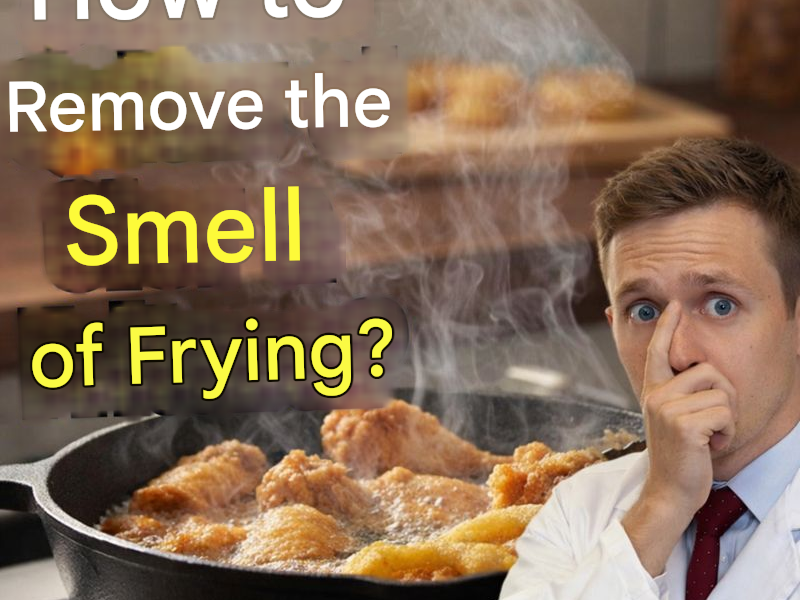
How to eliminate the smell of frying in the house effectively and backed by studies

Few things are as annoying as coming home hours — or even days — after frying food and finding that the smell is still there, permeating the kitchen, furniture, and even clothes. Venting helps, but it rarely fixes the problem completely. The smell of frying has a surprising ability to linger, reappear and mix with other aromas, generating a persistent sensation of dirt or stale air.
The good news is that this problem has a scientific explanation… and also simple, economical and effective solutions. Understanding why the smell is so persistent is the first step to really eliminating it and not just hiding it.
Why the smell of frying doesn’t go away easily
When frying food, especially fish or protein-rich products, not only odor is released into the air. During frying, microdroplets of grease are generated that are suspended and then deposited on surfaces such as walls, furniture, curtains, appliances and textiles.
These microdroplets act as odor carriers. Although the air is renewed, the greasy particles remain attached and release odor again with the passage of time, heat or humidity. That’s why air fresheners only “cover” the problem: they don’t eliminate the cause.
From a chemical point of view, these are volatile compounds that bind to fat. To eliminate them, it is necessary to neutralize or dissolve these particles, not just perfume the environment.
Effective methods to prevent and neutralize frying odor
1. Immediate neutralization with acid steam
During or just after frying, generating water vapor with an acidic component (such as vinegar) helps dissolve airborne fat droplets before they settle. Steam acts as a vehicle for environmental cleaning and significantly reduces the olfactory load.
This method is based on well-known principles of emulsion and fat dissolution, widely used in industrial and domestic cleaning.
2. Subsequent flavoring, only after neutralizing
Once the main smell has been neutralized, the environment can be enhanced with natural aromatic vapors (citrus, spices or herbs). This doesn’t eliminate the odor on its own, but it does provide a real clean feeling when the grease has already been treated.
3. Residual odor absorption
When the odor has already permeated, certain materials with high absorption capacity help capture volatile compounds from the environment. Hygroscopic and porous substances can progressively reduce the intensity of the odor within 24 to 48 hours.
4. Neutralization of old odors
In cases where the smell has been installed for days, more complex compounds appear, especially sulphur. Some natural substances release compounds that react with them, gradually neutralizing them instead of covering them up.
Other practical advice backed by science
- Partially covering the pan during frying reduces the dispersion of microdroplets without affecting cooking.
- Keeping the oil at the correct temperature prevents it from degrading and releasing more odoriferous compounds. Superheated oil generates more odor and more volatile particles.
- Change the oil frequently: Reused oils accumulate residues that intensify the smell.
- Cleaning hot surfaces (hood, nearby tiles) after frying is finished prevents grease from solidifying and trapping the odor.
- Washing nearby textiles (towels, curtains, tablecloths) even if they don’t look dirty – they are great odor accumulators.
- Avoid immediate chemical air fresheners: they can react with fatty compounds and generate even more persistent odors over time.
Eliminating the frying smell does not require expensive products or complex solutions, but rather understanding the source of the problem. When the microscopic fat that carries the smell is acted upon – and not just the air – the result is much more durable and effective.
The difference between a house that “smells like food” and one that quickly feels clean again is in neutralizing, absorbing, and only then scenting.
👉 Follow our page, like 👍, and share this post. Every click can make a difference—perhaps saving your own life or that of a loved one.