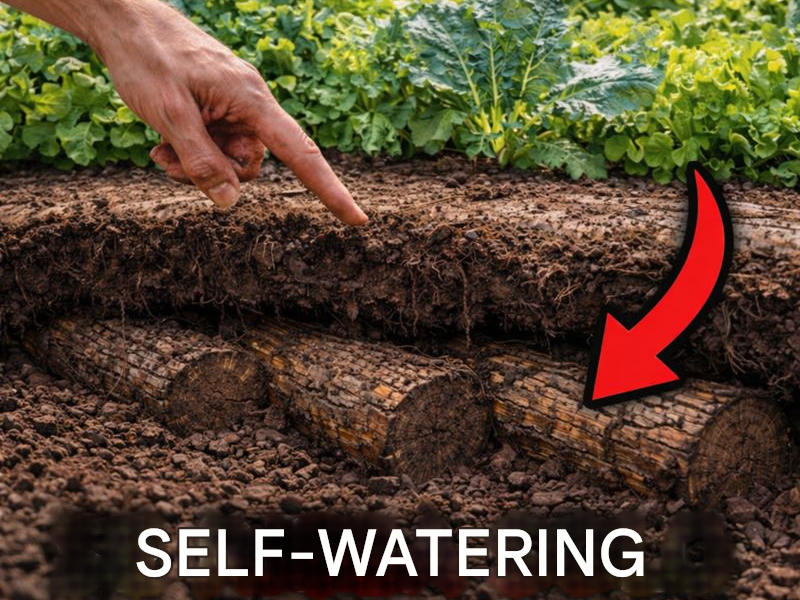
This system allows you to keep plants without watering for long periods… and why it generated so much controversy
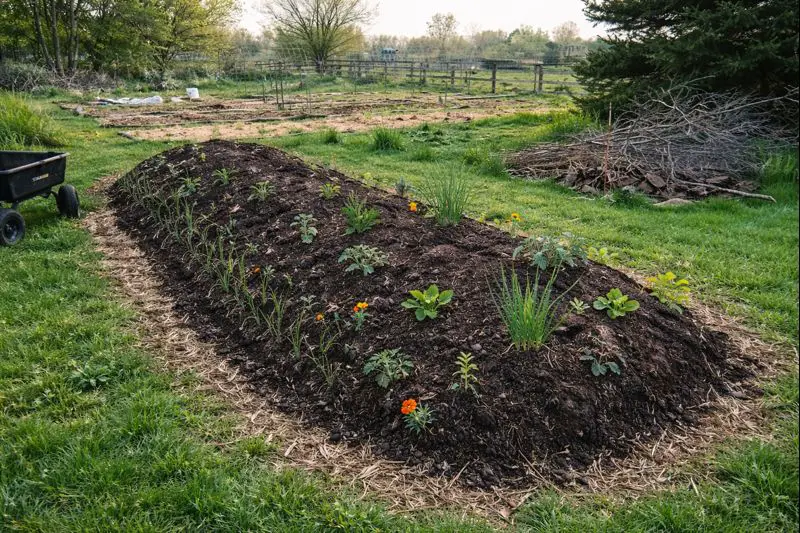
In the 1980s, a farmer from the Alps challenged everything that conventional agronomy took for granted. While most were battling drought and frost, he opted for something that seemed crazy: burying large amounts of wood underground. The authorities fined him, his neighbors mocked him… and yet their crops thrived where others failed.
That farmer’s name was Sepp Holzer, and the system he advocated would end up becoming one of the most hotly debated techniques in modern natural farming.
The context: when innovation seemed like a crime
At that time, the rule was clear: flat fields, bare soils and constant irrigation. Holzer did the exact opposite. He built raised ridges, buried trunks and branches in various states of decay, and let nature do the rest.
The result was so uncomfortable for the system that it received official fines and warnings. However, while neighboring crops were lost due to the cold or lack of water, fruits, vegetables and even lemons grew on his farm… No artificial watering.
The secret behind Hugelkultur (ridge farming)
The method is known as Hugelkultur, a technique that transforms old wood into a natural reservoir of water and nutrients. Its principle is simple, yet powerful:
- Buried wood acts like a sponge.
- It absorbs water during rain or thaw.
- It releases it slowly over weeks or months.
- As it decomposes, it feeds the soil.
This system can maintain soil moisture for years, drastically reducing the need for irrigation and improving fertility over time.
The science of the “living sponge”
A decaying log can retain up to five times its own weight in water. Unlike compacted soil, which loses moisture quickly, a ridge with buried wood:
- Regulates the temperature of the soil.
- Protects the roots from frost.
- Prevents excessive evaporation.
- Encourages beneficial microbial life.
Therefore, in extreme climates – cold or dry – this system usually surpasses traditional agriculture.
The Common Mistake: Burning Branches and Losing Resources
One of the great failures in orchards and fields is to burn pruning remains. This loses:
- Potential water stored.
- Long-lasting organic matter.
- Natural soil structure.
In Hugelkultur, those same branches become a water and nutrient reserve that can last up to 20 years.
The nitrogen trap: the mistake that many beginners make
It’s not all about burying wood without thinking. There is a critical error:
- Fresh wood consumes nitrogen during its decomposition.
- If not balanced with green material, compost, or manure, plants can become weakened.
The key is to combine layers: wood, green remains, fertile soil and plant cover. Thus, the system becomes stable and productive from the beginning.
Why it continues to generate controversy
This method questions pillars of industrial agriculture: constant irrigation, chemical fertilizers and extreme soil control. For many, accepting that nature can work alone is uncomfortable.
But the results are there: less water, less work and more lively soils.
An invitation to change the approach
To stop being a slave to the hose is not a utopia. It’s a decision. Hugelkultur shows that when the natural functioning of the soil is understood, farming can be simpler, more resilient and sustainable.
Letting nature work for us is not abandonment: it is applied intelligence. Below, you can see it in the following video from the Hidden Harvest channel:
👉 Follow our page, like 👍, and share this post. Every click can make a difference—perhaps saving your own life or that of a loved one.